The Siesta (after Millet)
Transcript
Here's what your guide tells you about this work in the MuseCat app.
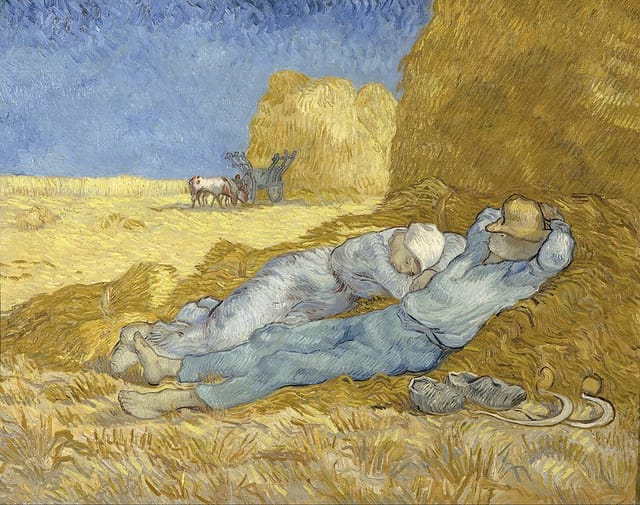
The painting you're looking at now is Noon: Rest from Work, also known simply as The Siesta, by Vincent van Gogh. This painting is Van Gogh's own interpretation of a work by another artist.
So here's a quick quiz. Whose painting do you think Van Gogh reimagined? Here's a hint. He was the nineteenth-century French painter best known for depicting the lives of peasants. Do you know who it is? That's right. It's Jean-François Millet.
Millet created a series called The Four Times of Day. This painting is Van Gogh's remake of one work from that series, titled Noon. There is also a drawing of Noon that looks especially similar to Van Gogh's painting. Van Gogh's composition is so close to Millet's drawing that the two are almost identical. The farmers' shoes and tools, and even the cow grazing in the background, are all copied directly from Millet's work.
But because Van Gogh recreated the scene in his own style, the overall mood is completely different. Millet's Noon is a pastel, while Van Gogh's Noon: Rest from Work is an oil painting. More generally, Millet's work feels soft but somewhat dark, while Van Gogh's version is bright and intense. The reason is Van Gogh's use of color.
The sky and the farmers' clothes are blue, while the bundles of wheat and the field are yellow. Blue and yellow are contrasting colors. When these two contrasting colors are placed side by side, each one makes the other appear even more vibrant.
This effect is known as complementary color contrast. It's a technique you'll notice again and again in Van Gogh's paintings. Here, he uses it to capture the intense summer sunlight and heat.
Among all the painters of his time, Van Gogh regarded Millet as one of the greatest modern artists. That's why he created so many paintings inspired by Millet's depictions of peasant life. Even so, as in the painting we're looking at now, Van Gogh always transformed them with his own bold and expressive use of color.
Take your time enjoying the painting.