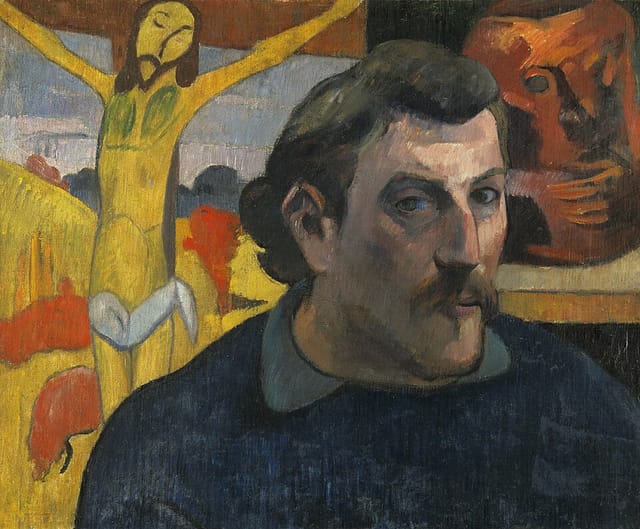
Self-Portrait with the Yellow Christ
Transcript
Here's what your guide tells you about this work in the MuseCat app.
The painting you're looking at is Self-Portrait with the Yellow Christ, in which Paul Gauguin depicted himself before setting off on his journey. Along with Van Gogh and Cézanne, Gauguin is considered one of the leading figures of Post-Impressionism. While the Impressionists focused on capturing fleeting effects of light, the Post-Impressionists sought to express the true nature of objects and the inner world of human beings.
Now, let's take a closer look at the painting. The figure in the center is Gauguin himself. His expression reflects his rough and sensitive personality.
Behind him are two paintings. The yellow painting of Christ on the left is The Yellow Christ. Gauguin painted Christ in yellow to challenge the prejudices people held. He also modeled Christ's face after his own. Next to it is a ceramic work titled Self-Portrait Jug in the Form of a Grotesque Head. Both of these are actual works created by Gauguin.
In The Yellow Christ, the figure is facing the opposite direction from the one in the self-portrait you're looking at now. That's because Gauguin painted this self-portrait while looking at himself in a mirror, so the image appears reversed. The Yellow Christ is now in the collection of the Buffalo AKG Art Museum in Buffalo, New York. The ceramic self-portrait on the right, however, is here at the Musée d'Orsay.
Now, back to the story. Gauguin had grown tired of life in the modern city. He believed that untouched places were filled with a pure kind of energy. So he decided to leave for the island of Tahiti in the South Pacific, hoping to find that exotic world. He painted this self-portrait in April 1891, just before leaving for Tahiti.
In The Yellow Christ on the left, Christ is stretching out his arms above Gauguin's head. This suggests that God would watch over and protect him. The rough-looking ceramic jug on the right, along with Gauguin's expression, conveys the anxiety he felt about leaving for an unfamiliar place. It stands in sharp contrast to the calm and gentle image of Christ. Through this painting, Gauguin reveals the uncertainty and anxiety he felt just before setting off on his journey into the unknown.
Take your time and enjoy the painting.