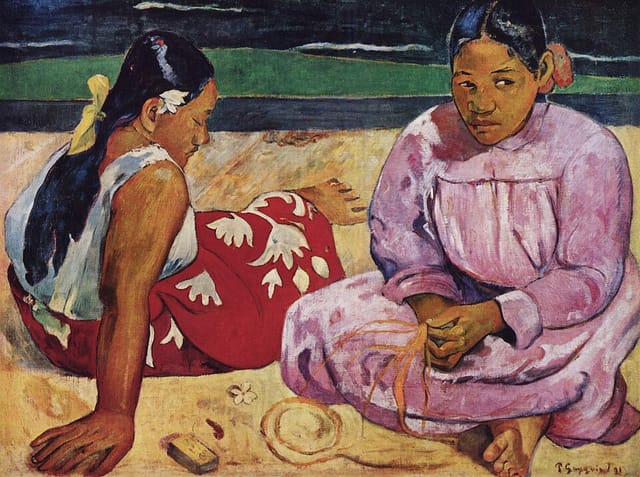
Tahitian Women on the Beach
Transcript
Here's what your guide tells you about this work in the MuseCat app.
The painting you're looking at is Tahitian Women by Paul Gauguin. The painting features two women. The woman on the left is wearing a pareo, the traditional clothing of the Tahitian people. The woman on the right, on the other hand, is wearing a pink dress introduced to Tahiti by European missionaries.
The traditional pareo is sleeveless and well suited to the tropical climate, making it look light and comfortable. The dress brought by the missionaries, however, was not suited to the island's climate. Because of religious beliefs about modesty, it was designed to cover most of the body. As a result, the woman wearing the dress appears rather uncomfortable. By placing these two women side by side, one in traditional clothing and the other in Western dress, Gauguin portrayed a Tahiti where traditional culture and a newly introduced culture coexisted.
Here at the Musée d'Orsay, you'll find many other paintings in which Gauguin depicted Tahiti. Gauguin first encountered exotic objects from the South Pacific at the 1889 Paris Exposition. From that moment on, he became deeply drawn to the idea of living in a new world surrounded by lush, jungle-like forests and an unfamiliar culture. So Gauguin left his life in Paris behind and set off for Tahiti, a French colony in the South Pacific. It was a long journey that took nearly two months by ship.
After such a long voyage, Gauguin finally arrived in Tahiti. But to his disappointment, it was already heavily colonized and filled with Europeans, nothing like the place he had imagined. Even so, there was no turning back to Paris, so he decided to settle there.
By today's standards, what he did next would be considered a crime. Gauguin began living with a thirteen-year-old Tahitian girl named Tehamana. During his time there, he painted many works inspired by Tahiti. This is one of them, and the young woman wearing the pink dress is Tehamana.
Now, take your time and enjoy the painting.