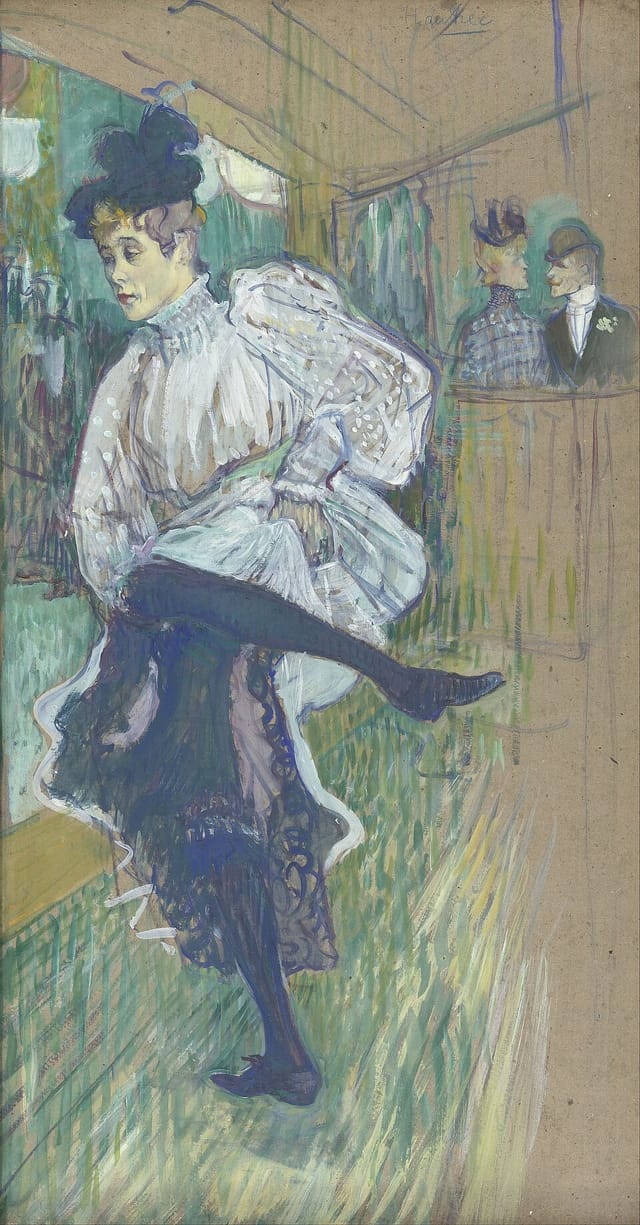
Jane Avril Dancing
Transcript
Here's what your guide tells you about this work in the MuseCat app.
The painting you're looking at is Jane Avril Dancing by Henri de Toulouse-Lautrec. Lautrec is one of my personal favorite artists. When I first started giving this tour, not many people were familiar with him. But these days, more and more visitors seem to know who he is. I think that's a sign that more people are becoming interested in art.
Now, let's take a closer look at the painting. As you can see, the composition is very simple. Jane Avril, dancing, occupies the foreground as the largest figure in the painting.
In the background, you'll notice a man and a woman standing together. We don't know who the woman is, but the man is said to be Warner, a theater manager. The way the two of them quietly stand facing each other makes Jane's energetic movement stand out even more.
Lautrec had an exceptional ability to capture the fleeting movement of dancers. In this painting, he captures the energy of the exact moment Jane Avril kicks her leg into the air. Lautrec was able to complete his paintings while the dancers were still moving, and honestly, the way he created such a strong sense of motion can only be explained by his extraordinary talent.
However, the type of paint he used also helps explain some of that movement. Take another look at the painting. Lautrec painted this work in oils. When we think of oil paint, we usually imagine thick, heavy layers of paint, don't we? But Lautrec thinned his oil paint heavily with turpentine, a technique known as peinture à l'essence, and painted on cardboard.
The cardboard soaked up the oil, so the paint dried quickly with a matte finish. That allowed Lautrec to apply color in a light, translucent way, just as you can see here. Using this method, he was able to express the dancer’s movements more effectively.
Thanks to this painting, Jane Avril became very famous and gained great popularity. At the time, Jane Avril was one of the most celebrated dancers in Paris.
If you've seen the movie Moulin Rouge!, you may remember the heroine, Satine, the star performer of the Moulin Rouge. She was inspired by Jane Avril. If you have time tonight, I highly recommend watching Moulin Rouge!. I think you'll appreciate it in a whole new way.
Now, let's take a moment to learn a little about Lautrec himself. Lautrec was born into an aristocratic family as the son of a count. But when he was young, he broke his legs in an accident, and the growth plates in his legs closed prematurely. As a result, he remained much shorter than most adults. He was quite small, and rather charming.
However, Lautrec carried deep emotional wounds. After the accident left him unable to grow any taller, his father essentially treated him as though he were no longer his son. Fortunately, his mother gave him unwavering love and supported his artistic education.
He later settled in Montmartre, where he became acquainted with many well-known artists. As an adult, he earned a living by designing posters for cafés and cabarets, and by painting dancers like the one you see here. But it seems the emotional scars left by his father never fully healed.
Throughout his life, Lautrec struggled with alcoholism and frequently visited brothels. He passed away at the young age of just thirty-six. Even so, the remarkable works he left behind continue to be admired today. There are more of Lautrec's paintings here for you to enjoy.
Take your time looking around.