The Spring
Transcript
Here's what your guide tells you about this work in the MuseCat app.
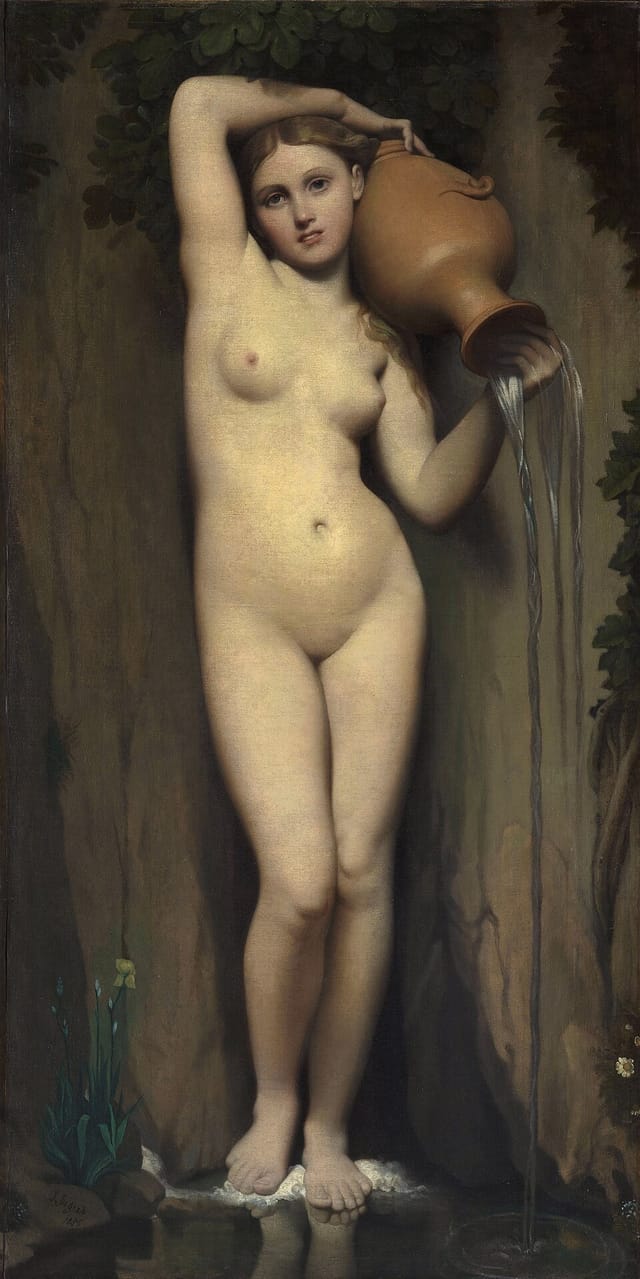
The painting you're looking at now is The Source by Jean-Auguste-Dominique Ingres, one of the leading painters of Neoclassicism. It is also considered one of his representative works. Ingres began working on this painting when he was forty years old and completed it at the age of seventy-six. That took an incredibly long time, didn't it?
While working on the painting, Ingres also received help from two of his students. The parts they helped with were the water jar and the background. That means Ingres spent as many as thirty-six years painting everything else, apart from the jar and the background.
Now, take a close look at the woman's body. Can you see how softly the skin is painted, almost as if you could feel the texture of a real woman's skin? Through thirty-six years of repeated brushwork, not a single brushstroke is visible. These are details you can only really notice when you see the painting in person. And that shows just how much care and dedication Ingres put into this work.
As you would expect from Ingres, one of the leading painters of Neoclassicism, this painting clearly reflects the key features of the Neoclassical style. First, the figure is painted almost like a Greek sculpture. The woman is standing in a pose often seen in ancient Greek statues, known as contrapposto. That's why the painting doesn't feel stiff. Instead, it looks natural.
Second, the subject comes from Greek mythology. Neoclassical artists often drew inspiration from stories of Greek and Roman mythology, as well as ancient history. This painting tells the story of Echo and Narcissus, the young man she loved.
One day, Hera was keeping watch on her husband Zeus, suspecting that he was having an affair. But Echo, who was known for being very talkative, distracted Hera with her endless chatter. And because of that, Hera lost sight of Zeus. Enraged, Hera punished Echo with a cruel curse. From that moment on, Echo could never speak first. She could only repeat the last words spoken by someone else.
One day, while wandering through the forest, Echo fell in love with a handsome young man named Narcissus. She desperately wanted to speak to him, but because of Hera's curse, she couldn't. And so, the two were never able to be together.
Narcissus, meanwhile, was so captivated by his own beauty that he rejected everyone who fell in love with him. Then one day, he caught sight of his reflection in a pool of water and fell deeply in love with it. When he finally realized it was his own reflection, he was overcome with despair and fell into the water, where he died. According to the myth, a single flower bloomed where Narcissus died. That flower is the daffodil.
Now, take a look at the lower left corner of the painting. Do you see the single flower beside Echo? That's the daffodil. And that's exactly why the flower's scientific name is Narcissus. Interestingly, the English word "echo" comes from the very same character in Greek mythology. Both echo and Narcissus are words that trace their origins back to this ancient myth.
In Greek mythology, Echo is a nymph of the forests and springs. That's why the woman in the painting is holding a water jar, with water continuously flowing from it and spreading across the ground at her feet. It's Ingres' way of reminding us that Echo is the nymph of the spring.
By the time Ingres completed this painting at the age of seventy-six, he was already one of France's most celebrated artists and was serving as president of the École des Beaux-Arts, one of the country's leading art schools. The painting attracted a great deal of attention from the very beginning, and many people hoped to acquire it. It was eventually purchased by the Count of Duchâtel. Later, his wife donated the painting to the French state. Today, it is in the collection of the Musée d'Orsay.
Now we've finished exploring The Source by Ingres.