The Fifer
Transcript
Here's what your guide tells you about this work in the MuseCat app.
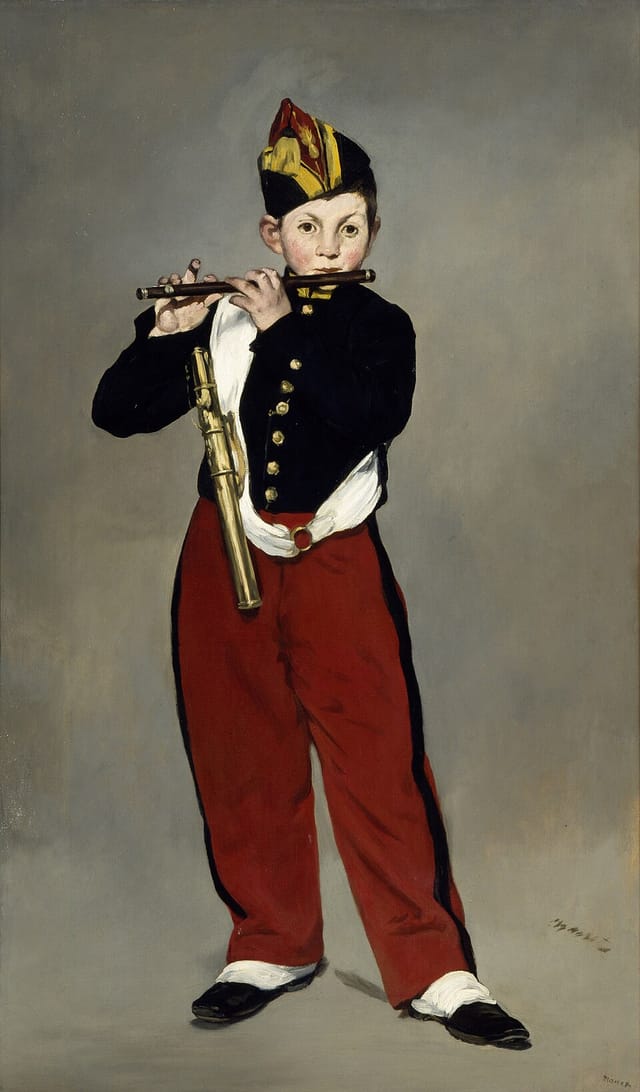
The painting you're looking at now is The Fifer by Édouard Manet. There's a saying that imitation is the mother of creation. Manet developed his own artistic style by studying the works of great masters and experimenting with different ideas. In the case of this painting, Manet was inspired by Pablo de Valladolid by Diego Velázquez, which is in the collection of the Prado Museum.
Manet was deeply impressed when he saw this painting at the Prado Museum. He even wrote about it in a letter to a friend. "It is the most astonishing painting I have ever seen. The background has disappeared, and all that surrounds the man dressed in black is air."
After realizing how much more the figure stood out without a background, Manet returned to Paris and asked a friend to find him a model. His friend introduced him to a young soldier who was part of the Imperial Guard's acrobatic troupe.
After completing the painting, Manet submitted it to the Salon. Once again, he was met with harsh criticism from the critics. That's because the illusion of space had always been considered an essential element of Western painting. Countless great artists had devoted enormous effort to creating a sense of depth. So when critics saw this painting, which looked almost flat, they saw it as a step backward for art.
But for Manet, this was another artistic experiment. Although the critics gave it poor reviews, the younger generation of artists who would later lead the French art world saw it as a bold and remarkable work. It also influenced the Impressionists, who went on to paint in a flatter style.
That concludes our introduction to The Fifer. Take your time looking at the painting.