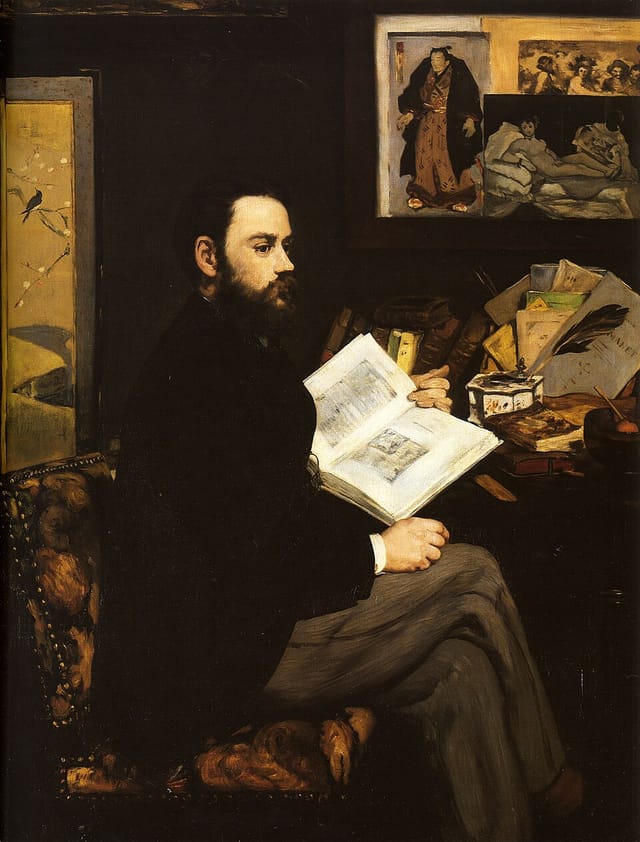
Portrait of Émile Zola
Transcript
Here's what your guide tells you about this work in the MuseCat app.
The painting you're looking at now is Portrait of Émile Zola by Édouard Manet. As you can see, the painting features a man. This is Émile Zola. In France, he was a well-known novelist and journalist. At a time when Manet's paintings were constantly criticized by art critics, Zola was one of the few people who publicly defended him. To express his gratitude, Manet painted Zola's portrait and presented it to him as a gift.
Now, let's take a closer look at the painting. The setting of this painting is Manet's studio. However, he didn't recreate the studio exactly as it looked at the time. Instead, he added several elements to express the close friendship and bond between the two men.
Let's take a look at some of them. First, look at the desk covered with books. You should notice a blue book among them. If you look closely, you'll see the name "Manet" written on its cover. This book is a collection of pamphlets containing the articles Zola wrote in defense of Manet. It was a very meaningful book to Manet.
Next, let's look at the paintings hanging on the wall above the desk. There are three paintings in total. The first is a black-and-white print of Manet's Olympia. As you may remember, Olympia was one of the paintings that received severe criticism from art critics. When everyone else was criticizing Olympia, Zola praised it as "a masterpiece created with the artist's flesh and blood."
It's easy to see why Manet grew so fond of Zola after receiving such praise for a painting that had been met almost entirely with criticism. The two men became very close friends. That's why Manet included Olympia in the portrait. It was a painting that held special meaning for both of them.
Behind Olympia is another painting, The Triumph of Bacchus, by the Spanish painter Diego Velázquez. At the time, many artists admired the Italian masters, but Manet was especially interested in Spanish art, and Velázquez was the artist he admired most. He drew a great deal of inspiration from Velázquez's work. Zola shared that admiration for Spanish painting as well. Because both Manet and Zola had a deep appreciation for Velázquez, Manet chose to include one of his paintings in the portrait.
Next, take a look at the picture to the left of Olympia. It shows a sumo wrestler. This is a Japanese ukiyo-e print, a type of woodblock print that was produced during the Edo period. You'll also notice a Japanese folding screen hanging to Zola's left.
During the years when Manet was active, the Parisian art world was captivated by a trend known as Japonism. People are naturally drawn to something new rather than what they're used to seeing. When paintings with a style completely different from the Western ideas of perspective and color began to appear, artists in Paris became fascinated by Japanese art. Manet and Zola were no exception. That's why Manet included Japanese artwork in the painting, reflecting one of the interests they shared. Japanese art also had a profound influence on Manet and, later, on the Impressionists, inspiring many artists to create paintings with a flatter style.
So far, we've looked at the details that show just how close Manet and Zola were. Now, let's take a look at what Manet really wanted to say through this painting. Now, look back at Émile Zola. As you can see, he is holding a very thick book in his hand. This book is The History of Painting, written by Charles Blanc.
Manet had been criticized by critics who claimed that his paintings lacked skill, or that he did not understand art. So through this painting, Manet seems to be making a statement: Zola, a man who reads serious books like this, praises my work. Therefore, my paintings are works of real artistic value. When Zola saw this portrait, he must have immediately understood what Manet was trying to say. And Zola himself was very fond of this painting.
Their friendship may have seemed as if it would last forever, but later, as Manet's artistic direction and Zola's ideas began to differ, the two men sadly grew apart. Even so, Zola kept this painting in his study until the day he died. After Zola's death, his wife lent it to the Louvre free of charge, and it remained there for a time before eventually being moved here to the Musée d'Orsay. That concludes our introduction to Portrait of Émile Zola.
If you'd like to spend a little more time with the painting, please do so.