The Painter’s Studio
Transcript
Here's what your guide tells you about this work in the MuseCat app.
The painting you're looking at now is another of Courbet's great masterpieces. Not only is it enormous, but it also has an unusually long title. Its full title is The Painter's Studio: A Real Allegory Summing Up Seven Years of My Artistic and Moral Life. Because the title is so long, most people simply call it The Painter's Studio. However, if you want to understand the painting's true meaning, the full title is important.
The key word is "allegory." An allegory is a way of expressing ideas through symbols rather than stating them directly. This painting is Courbet's symbolic reflection on the first seven years of his artistic career and the experiences that shaped him.
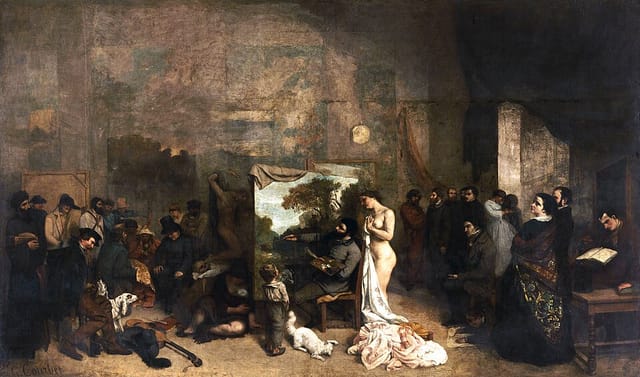
Now, let's take a closer look at the painting. The setting is Courbet's studio. In the center of the composition, you'll see a man painting at an easel. The man is Courbet himself. As you can see, he's painting a landscape. Behind him stands a nude woman, quietly looking at the canvas.
What does this mean? By turning away from the nude model, a symbol of the academic tradition, and choosing instead to paint a landscape, a genre that was not highly valued at the time, he was challenging an art world that remained devoted to classical ideals. Some scholars, however, interpret the nude woman as a symbol of Truth. There is no universal agreement, so her exact meaning remains open to interpretation.
Now, look at the group of people on Courbet's right. These are the people who supported him, both intellectually and financially, throughout his artistic career. First, do you see the man sitting in a chair at the far right, reading a book? He is the poet Charles Baudelaire, one of Courbet's closest friends and a devoted supporter of his work.
The two were so close that Courbet originally included Baudelaire's girlfriend, Jeanne Duval, standing beside him in the painting. Later, after the couple separated, Baudelaire asked Courbet to paint her out. If you look carefully, you'll notice that her figure is no longer visible. But traces of her still remain beneath the paint. Take a close look beside Baudelaire.
Now, notice the man with the red beard. He is Alfred Bruyas, one of Courbet's most important patrons. There's also another man seated in a chair. He is Champfleury, the art critic who strongly supported Courbet and his work. Together, the figures on Courbet's right represent the people to whom he felt grateful.
The figures on his left, however, represent the society of his time. In a letter to a friend, Courbet described the people on this side as "those who live in the world of death." Here you'll find people from every level of society, including Napoleon III, merchants, hunters, beggars, and even a Chinese man. You'll also notice a man posed like Christ on the cross behind the easel. He is often interpreted as symbolizing the death of Academic art. On the ground to the left lie a guitar and a dagger, which are commonly understood to represent the decline of Romanticism. Through this painting, Courbet was, in effect, saying, "This is the world that exists in my studio."
After completing the painting, he submitted it to the Exposition Universelle in Paris. Officially, it was rejected because the painting was considered too large. But many believe the real reason was that Courbet had already made powerful enemies after the controversy surrounding his works at the Paris Salon five years earlier. Around 5,000 works from many different countries were exhibited at the Exposition.
After his painting was rejected, Courbet built a temporary pavilion next to the exhibition grounds and displayed about forty of his own works there. He called his exhibition Realism, and it was there that the term Realism became firmly established as the name of a new artistic movement. Courbet was so confident in his work that he charged the same admission price as the Exposition Universelle. One of the visitors was Eugène Delacroix. After seeing The Painter's Studio, he reportedly wrote, "They have rejected one of the most extraordinary works of our time." It was high praise from one of France's greatest painters.
Even so, the exhibition failed to attract much public attention. The painting later passed to Courbet's sister. After changing hands through several owners, it was eventually acquired by the Louvre and was later transferred here to the Musée d'Orsay.
As you can imagine, a painting of this size was difficult to preserve. Over the years, it suffered some damage. In 2014, the damaged areas were carefully restored through funding from public donations and the Louvre.
That concludes our look at Realism. Just as revolution and political upheaval transformed French society, they also brought dramatic changes to the world of art.
And those changes would soon lead to an even greater artistic revolution.