The Angelus
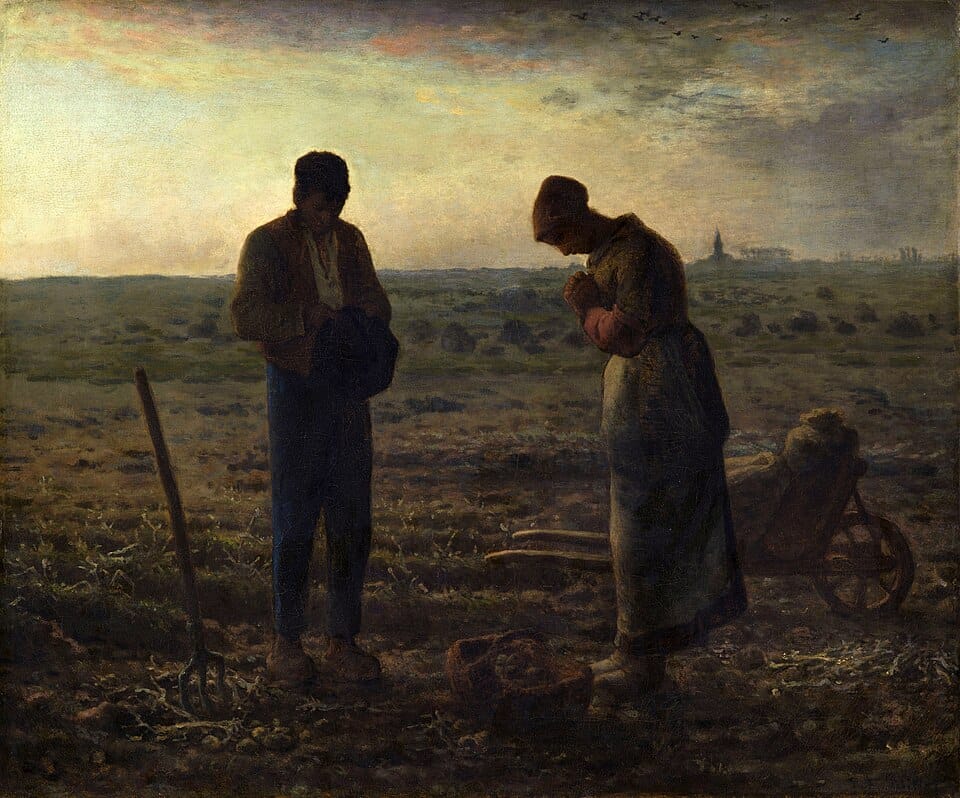
The painting you're about to see is The Angelus, one of Millet's most famous works.
Take a look at the painting. A man and a woman have stopped working in the fields. Hearing the church bells ring, they pause and begin to pray. Their quiet posture creates a deeply religious and solemn atmosphere.
The original French title is L'Angélus, which means the Angelus prayer.
In Catholic tradition, the Angelus is a prayer recited three times a day: in the morning, at noon, and in the evening.
This painting was inspired by Millet's childhood memories. When he was working in the fields, the sound of the evening church bells would signal everyone to stop their work, and his grandmother would pause to say the Angelus prayer.
Millet was born into a farming family. Except for the years he spent in Paris, he lived most of his life in the countryside.
For him, rural life wasn't simply a subject to paint—it was the life he knew best. That's why so many of his paintings depict farmers and the countryside.
Because The Angelus became so famous, another story eventually began to circulate. Some people claimed that the painting wasn't originally about prayer at all, but about a husband and wife burying their dead child.
Quite a dramatic change—from a touching story to something almost like a thriller.
Take a closer look at the painting. Can you see the basket placed on the ground between the man and the woman?
It's actually a basket of potatoes.
For a time, however, a rumor spread that it had originally contained the body of a dead infant, and that Millet later painted over it, turning it into a basket of potatoes.
Even today, you'll occasionally hear that story.
The person who first made this claim was the famous Spanish painter Salvador Dalí. Dalí said that when he looked at this painting, he didn't feel a sense of peace or devotion. Instead, he felt something deeply unsettling. He believed the basket originally held the body of a dead child.
He was so fascinated by this idea that he even created paintings inspired by The Angelus.
The story gained even more attention when The Angelus was examined with X-rays. The scans revealed that the basket had originally been painted as something else before Millet painted over it.
As a result, many people began to believe that Dalí's theory had been correct all along.
In reality, though, that conclusion doesn't hold up very well. Artists in the nineteenth century were often extremely poor and couldn't afford to waste canvases. It was common practice to paint over earlier compositions and reuse the same canvas.
Millet himself struggled financially for much of his life, so it would have been perfectly natural for him to repaint parts of the work.
And Millet scholars have rejected this theory.
Their reason is quite simple. Even the poorest families would have used at least a few basic items for a burial, yet none of those objects appear anywhere in the painting.
It seems that, because this painting is so famous, the many stories surrounding it make it even more fascinating.
This painting was originally created for a buyer.
But for reasons that remain unclear, the buyer suddenly canceled the purchase.
As a result, Millet fell into financial hardship.
Feeling sorry for him, an art dealer bought the painting as a way of supporting him and later resold it.
After that, The Angelus became enormously popular in the United States.
At the time, American society was still strongly influenced by Puritan values, which emphasized modesty, hard work, and religious devotion.
Because of this, Millet's image of a quiet, devout rural life appealed deeply to American audiences.
When The Angelus later appeared at auction, the American Art Association and the Louvre competed fiercely to acquire it. In the end, it was purchased by the American Art Association.
The Louvre wanted to bring the painting back to France, but the price was simply too high.
Later, Alfred Chauchard, a French department-store magnate, bought The Angelus and donated it to the Louvre. The painting remained there until the Musée d'Orsay was created. When the collection was transferred here, The Angelus came to the Musée d'Orsay, where we can see it today.
That concludes our look at The Angelus.
Please take a little more time to enjoy the painting. When you're ready, let's move on to the next masterpiece together.