Olympia
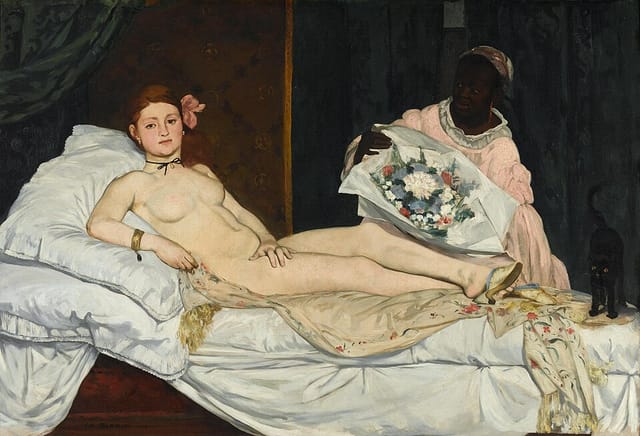
The painting you're looking at now is Olympia, one of Édouard Manet's most famous masterpieces.
As you can see, a nude woman is lying on a bed. Beside her, a Black maid holds a bouquet of flowers that has been delivered to her.
This is a nude painting, just like Cabanel's The Birth of Venus, which we looked at earlier today.
Both works were also submitted to the Paris Salon in the same period.
And yet, even though both were nude paintings, Cabanel's work was celebrated, while Manet's was fiercely criticized.
At first glance, they may not seem so different.
So why did Manet's painting provoke such outrage among critics?
There were two main reasons.
The first was that Manet did not paint the nude woman as a goddess. He painted her as a Parisian prostitute.
Now, take a look at the woman's neck.
You'll notice that she's wearing a black ribbon around her neck, and there's a bracelet on her right wrist.
These were accessories commonly associated with Parisian prostitutes at the time.
And then there's the title of the painting: Olympia.
Back then, Olympia was one of the most common names used by prostitutes in Paris.
The name became famous after the French novelist Alexandre Dumas fils gave it to a courtesan in his bestselling novel La Dame aux Camélias. The book was such a sensation that many Parisian prostitutes began calling themselves Olympia.
So, from both her accessories and even her name, we can tell that Manet intended to portray this woman not as a goddess, but as a prostitute.
Nowadays, you might wonder why there was such a fuss over painting a prostitute. But back then, simply depicting the nude of a prostitute was enough to cause a huge controversy.
That's because, according to the rules of academic art, female nudes were only considered acceptable if they represented figures from the Bible, history, or goddesses from Greek and Roman mythology.
Of course, if you think about it, the reason people painted nude women in the past was because buyers wanted them for voyeuristic purposes.
But in academic art, this was carefully disguised under the names of mythology and other subjects.
If you look only at the paintings themselves, Manet's Olympia is not very different from the nude paintings created by the great masters before him.
I've included a reference image of Venus of Urbino by Titian, which is widely believed to have inspired Manet when he painted Olympia. Please take a look.
You'll notice that the two paintings are remarkably similar.
Both feature a nude woman reclining on a bed with a maid standing beside her. In Titian's painting, there's a dog, while in Manet's painting, it's replaced by a black cat.
When Titian painted Venus of Urbino, Venice was culturally open and wealthy due to the growth of commerce, so there were many prostitutes in the city.
It was quite similar to Paris when Manet painted this work.
According to one theory, the model for Titian's Venus was also a well-known prostitute in Venice at the time.
But because she was presented as a goddess, it wasn't considered a problem.
The same was true of The Birth of Venus by Alexandre Cabanel. Although it was also a nude painting, it was presented as a goddess, so it caused no controversy at all.
Not only was it not considered a problem, but it was also praised by critics.
Manet, however, did not disguise his nude as a goddess. Instead, he boldly gave the painting the name of a prostitute, challenging the traditions of academic art.
As the saying goes, "The nail that sticks out gets hammered down." It was only natural that such an attempt would be met with harsh criticism.
There was also a second reason why critics attacked Manet.
His painting exposed the hypocrisy of the French bourgeoisie.
At the time, bourgeois men presented themselves as cultured gentlemen in public, but behind closed doors, many of them associated with prostitutes or even kept them as mistresses.
If you look at Olympia, you'll notice a Black servant standing on the right.
In those days, prostitutes who could afford to have servants were considered high-class courtesans. They were financially supported by wealthy bourgeois men as their mistresses.
The jewelry Olympia is wearing was also expensive, and it would have been given to her as gifts from those bourgeois men.
And if you think about it, the critics judging this painting were themselves members of the French bourgeois class.
That's why they disliked this painting. It exposed their own hypocrisy to the public, and that was why they criticized it.
In fact, this wasn't the first time critics had attacked Manet over a nude painting.
A little later, we'll be looking at Manet's The Luncheon on the Grass.
In that painting, created before Olympia, Manet had already depicted the nude of an ordinary woman, and it had drawn heavy criticism.
So when he painted another work like this, the critics were unlikely to look kindly on an artist who refused to listen to them.
Even so, Manet never let other people's opinions shake him. Instead, he continued to develop his own artistic vision.
That's why some people consider Manet's Olympia, which expressed his unique artistic vision, to be the beginning of modern art.
That concludes our introduction to Manet's Olympia.
Feel free to spend a little more time with the painting, and when you're ready, we'll move on to the next artwork.