The Luncheon on the Grass
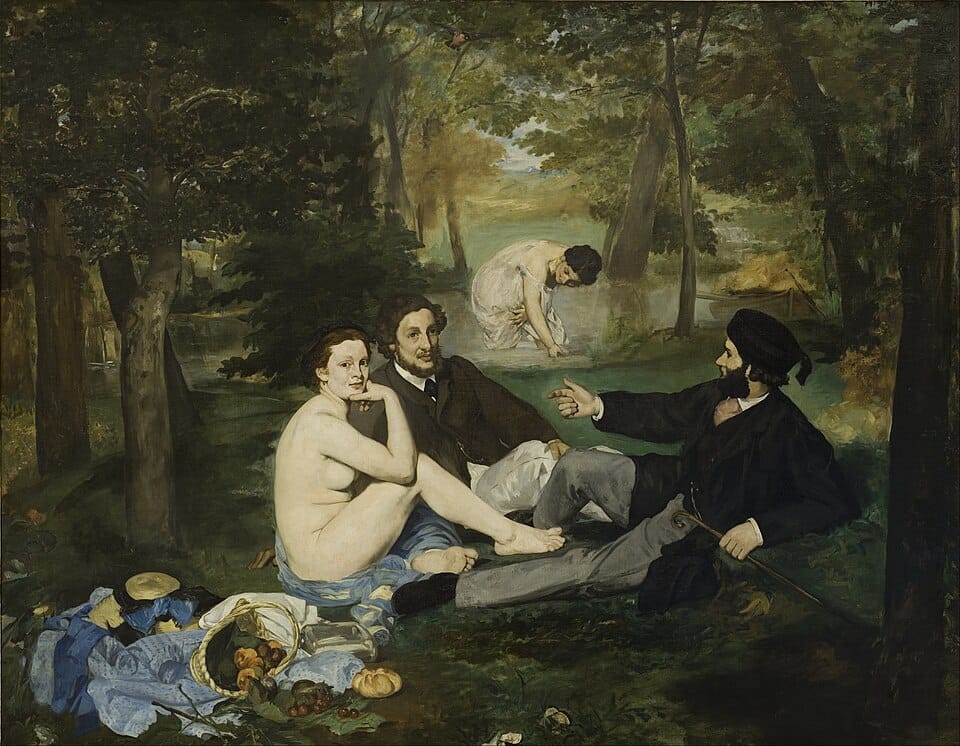
The painting you're looking at now is Luncheon on the Grass by Édouard Manet.
It was submitted to the Salon of 1863.
So, what happened?
As you might expect from Manet, whose works were often rejected, this painting was rejected as well.
At the time, however, the Salon jury was being exceptionally strict.
Many masterpieces, not just this one, were turned down.
As a result, the rejected artists came together and strongly protested the organizers' decision.
News of the controversy eventually reached Emperor Napoleon III.
After hearing their arguments, he agreed that the artists had a valid point. He said, "I understand the disappointment of the rejected artists, but the jury's decision cannot be reversed.
Instead, I will arrange a separate exhibition featuring only the rejected works."
For the rejected artists, there was no reason to refuse. If an exhibition was held, it would give them a chance to show their paintings to the public.
And so, the Salon des Refusés was held, featuring only works that had been rejected from the official Salon.
Here, Manet's painting once again received harsh criticism from the public.
So why did people criticize this painting so strongly? Let's continue by looking closely at the painting.
First, take a look at the nude woman.
This woman is Victorine Meurent, one of Manet's regular models.
At the time, if a woman was painted nude, it was only considered acceptable if she was a figure from mythology, a goddess, or an important figure from history.
Someone like Venus, for example.
But Manet painted an ordinary model as a nude.
To viewers at the time, this made the painting seem highly indecent.
What's more, the woman is nude while the two men beside her are fully dressed.
What does that suggest? Prostitution.
Many people interpreted the painting as depicting the prostitution that was openly practiced among bourgeois men at the time.
Most of the visitors who came to see this painting were probably from the middle or upper classes.
To them, it must have felt as though the painting was exposing their private lives. That's one of the reasons why they reacted so negatively to it.
However, it has never been proven that this was Manet's actual intention.
A more convincing explanation is that Manet wanted to be accepted by the traditional Salon, so he created this painting by combining elements from two classical works that the judges admired.
One of them is a work by Marcantonio Raimondi.
Do you notice that the figures I highlighted are in exactly the same poses?
Manet borrowed the poses of the figures from this engraving. Now, take a look at the next image. This painting is Pastoral Concert, a work believed to have been painted by either Titian or Giorgione.
Manet drew inspiration from its landscape when creating the background of his own painting.
However, people did not see Manet's work as a respectful reinterpretation of classical art. Instead, they saw it as an indecent painting simply because it depicted an ordinary woman without clothes.
That's why Manet's painting was met with such harsh criticism.
Even so, his bold approach became a great source of inspiration for the young Impressionist painters.
Thanks in part to artists like Manet, art continued to evolve in new directions.
That concludes our introduction to Luncheon on the Grass.
If you'd like to spend a little more time with the painting, please do so. When you're ready, we'll move on to the next artwork.