Starry Night Over the Rhône
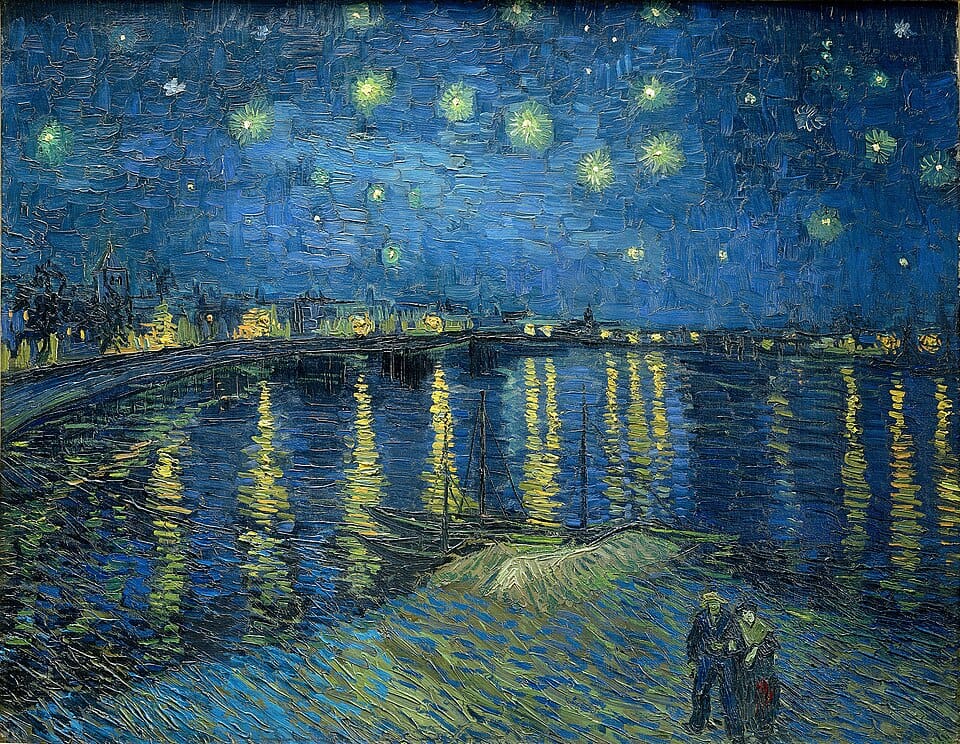
The painting you're looking at now is perhaps the most famous work in the Musée d'Orsay.
It is Vincent van Gogh's Starry Night Over the Rhône.
Because it is one of the museum's most popular paintings, you'll usually find a crowd gathered in front of it.
Please find a spot where you can see the painting clearly, and let's take a closer look together.
After leaving behind his difficult life in Paris, Van Gogh moved to Arles.
The time he spent there was one of the happiest periods of his life.
You can clearly feel that in this painting.
It is filled with warmth, happiness, and hope.
Now, let's take a closer look.
The scene depicts the Rhône River in Arles at night.
If you look up at the sky, you'll see the stars.
The seven stars in the middle represent the Big Dipper.
I've marked them on the image, so please take a look.
Now lower your gaze to the town across the river. You'll notice warm orange lights glowing between the buildings.
These are the gas lamps that illuminated the town.
The reflections of the town's lights stretch across the surface of the river.
And in the lower right corner of the painting, you'll notice a couple taking a quiet evening walk.
What we should pay the closest attention to in this painting is Van Gogh's use of color to depict the night.
After arriving in Arles, Van Gogh became fascinated with painting the night.
He wrote to his brother Theo that he wanted to paint a starry night. He also told his sister that the colors of the night were richer than those of the day.
Van Gogh believed that the night was filled with vibrant purples, blues, and greens.
To most of us, the night sky simply looks black and dark. But Van Gogh saw purple, blue, and green within it.
That's why, if you look closely, you'll notice that he didn't use any black paint for the night sky.
There's one more interesting detail. Blue and yellow are complementary colors. When they're placed side by side, each makes the other appear even more vivid.
That's why the yellow stars seem to glow so brightly against the deep blue sky.
Below them, the reflections of the town's lights are painted with long, broken brushstrokes, creating the impression that the light shimmers and moves with the ripples of the Rhône River.
It's truly an extraordinary painting.
One more thing. Van Gogh's paintings feel very different in person than they do in books or on a screen.
That's because the texture of the paint is incredibly pronounced.
It's a quality that photographs simply can't fully capture.
Without getting too close, step a little closer to the painting.
Can you see how thickly the paint has been applied?
This is called the impasto technique, one of Van Gogh's favorite ways of painting.
What do you think?
You can really appreciate the texture when you see it in person, can't you?
That's one of the reasons Van Gogh's paintings are best experienced in person.
Every now and then, someone looks at this painting and says,
"Wait... this isn't the Starry Night I know."
If that's what you're thinking, you're probably remembering the other Starry Night.
However, it's not here at the Musée d'Orsay. It's in the Museum of Modern Art in New York.
Although both paintings feature a starry night, they have very different moods, don't they?
The Starry Night in the Museum of Modern Art in New York is far more intense, dynamic, and turbulent.
Van Gogh painted it just one year after completing Starry Night Over the Rhône, the painting we're looking at now.
At that time, he was staying at the asylum in Saint-Rémy, receiving treatment for a number of mental health conditions.
As a result, the painting conveys a powerful sense of emotional turmoil.
In contrast, doesn't Starry Night Over the Rhône feel much calmer and more peaceful?
Van Gogh loved the warm atmosphere of Arles. It was there that he began to discover and develop his own artistic style, and he was filled with hope for the future.
That sense of happiness can be felt not only in this painting, but throughout the works he created in Arles.
In fact, I've heard that this painting is sometimes used in art therapy for people experiencing emotional distress.
The deep blue tones in Van Gogh's work are said to have a calming effect.
It's a truly beautiful painting. Take your time enjoying it, and when you're ready, we'll move on to the next artwork.