The Gleaners
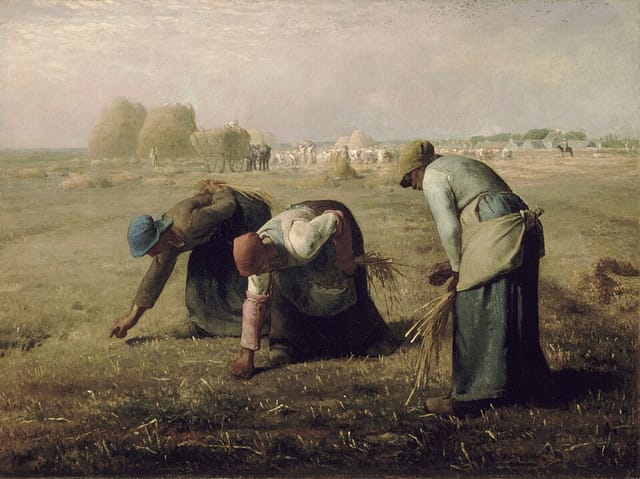
The painting we're looking at now is The Gleaners, one of Millet's most famous masterpieces.
Millet spent nearly ten years studying the subject of gleaning before creating this work.
Now, let's take a closer look at the painting.
The scene is set in a field near Barbizon.
In the foreground, three women are picking up ears of grain left on the ground.
These women are not farmers who own the field.
They are poor laborers who have come after the harvest to gather what remains.
For centuries, people who had no land of their own, or who were too poor to farm, survived by collecting leftover grain from other people's fields after the harvest.
Now, look at the pouch tied around the waist of the woman on the right, the one standing slightly bent over.
You can see that the pouch is almost empty.
Now compare these women with the enormous stacks of harvested grain in the background. The contrast makes their situation all the more poignant.
Millet also conveys just how physically demanding this work was. Each woman is shown in a different stage of gleaning—one bending down, one gathering the grain, and one beginning to stand up again.
Just looking at them is enough to make your back ache.
In earlier times, allowing poor people to gather the leftover grain after the harvest was considered an act of kindness.Landowners would simply let them take what remained in the fields.
So although the work was exhausting, these women could at least gather grain with gratitude and dignity.
But by the mid-nineteenth century, when Millet painted this work, things had begun to change. Thanks to the Industrial Revolution, transportation improved, and grain harvested in the farmland around Barbizon—just fifty kilometers from Paris—could be shipped quickly to the growing city. As landowners became more concerned with making a profit, many no longer allowed poor people to collect the leftover grain for free. Instead, they demanded payment even for what had been left behind.
As a result, public opinion toward landowners was particularly negative at the time.
It was in this social climate that Millet exhibited The Gleaners at the Paris Salon.
The painting was met with harsh criticism from many members of the bourgeoisie and from art critics.
They believed it looked like a criticism of the growing gap between the rich and the poor.
Of course, Millet wasn't the first artist to paint farmers.
But while earlier painters usually portrayed the countryside as beautiful and idyllic, Millet chose to depict rural life as it really was. By presenting the reality of life in the countryside, the painting exposed an uncomfortable truth that many people preferred not to see.
After all, most of the people who visited the Salon were members of the middle or upper classes.
Some even accused Millet of painting it with a political agenda.
But that wasn't the case. Millet was not a political painter.
He was simply an artist who portrayed the French countryside with remarkable honesty.
It is also a work that is frequently loaned for major exhibitions.
If you're seeing it here at the Musée d'Orsay today, take a moment to enjoy it up close.
When you're ready, let's move on to the next painting.