The Virgin of the Rocks
Transcript
Here's what your guide tells you about this work in the MuseCat app.
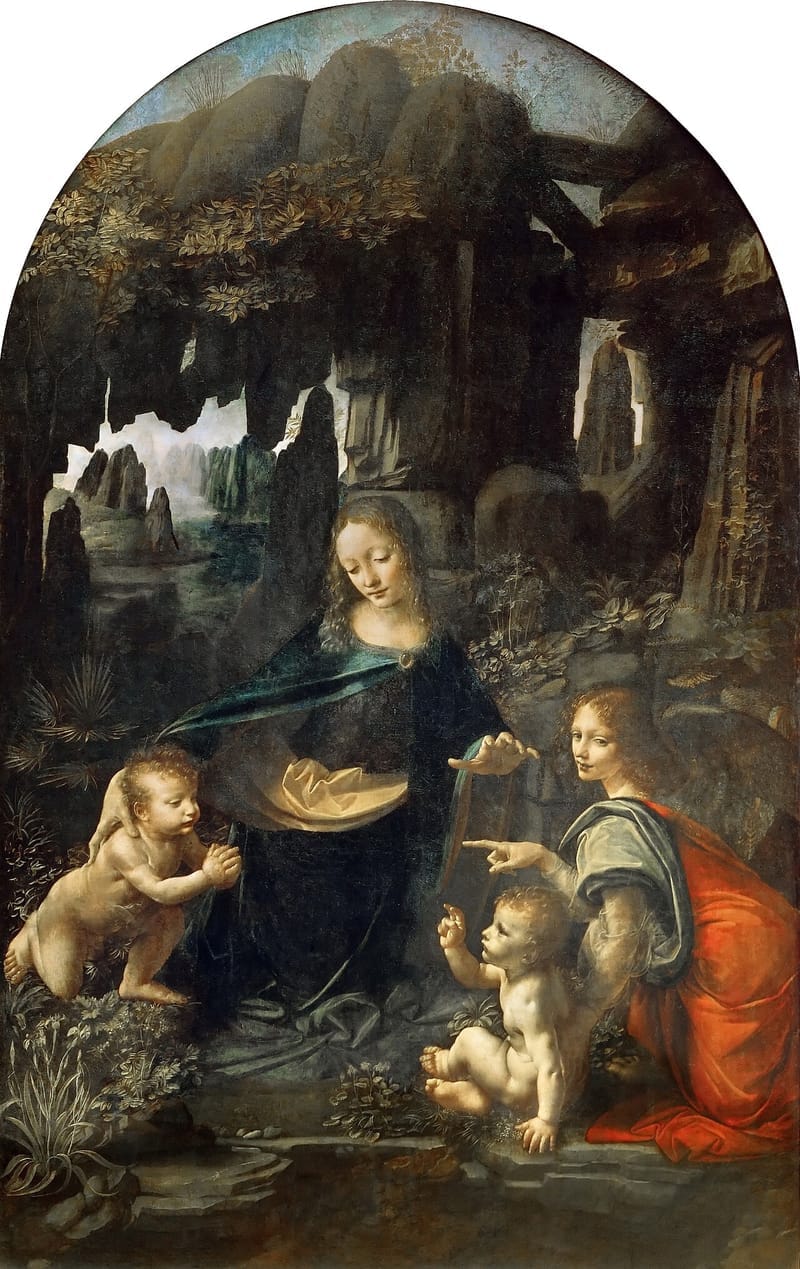
This is the Virgin of the Rocks. Painted in the 1480s. In the center is the Virgin Mary. There are two children. And the figure on the right, in red clothing, isn't a person. It's an angel.
Which of the two children is Jesus? If you said the one on the left, that makes sense: a mother usually holds her child in her arms. It's a very human answer. If you said the one on the right, you've been listening very carefully from the beginning. Look at the finger gesture. That's the key. Only Jesus can make it. That child, the one on the right, is Jesus.
But at first glance it seems like the protagonist is the other child. Mary embraces him. And the angel points at him with a finger. That's John the Baptist. It makes sense. According to the Bible, this is their first meeting. John was born six months before Jesus, so here he appears a bit bigger. And if you look at the Bible, John the Baptist wore clothes made of camel hair, as written in the Gospel. Jesus, on the other hand, wears no clothing.
This painting was a scandal. A religious community commissioned it, and when they saw it, they protested strongly. Why? First: John seems like the protagonist, not Jesus. Second: none of the figures have a halo. Third: look at the angel's eyes. The angel is looking outside the painting, directly at you. That wasn't appropriate for a religious painting. Everything in this painting was a problem.
Da Vinci worked hard on it but in the end he wasn't paid. So he had no choice but to paint another version. That second version is today in the National Gallery in London.
Now let's compare the two versions. What's changed?! Halos: they appear on all the figures. The angel: the color of the clothing changes. The pointing finger: it disappears. The angel's eyes: they no longer look outside the painting, they look slightly downward. And John: he holds a staff in his hand so there's no confusion about who he is. Da Vinci painted exactly what the church asked him to.
Now look at the technique. Do you see how everything emerges from the darkness? That's called sfumato. Da Vinci first painted dark, then added layers of lighter color on top, and sometimes blended with his own fingers. When they analyzed his paintings with infrared, they found fingerprints on the surface. His fingerprints.
And look at the composition. The figures fit inside an invisible triangle. That's triangular composition, one of the hallmarks of the High Renaissance. And the background. The farther away, the more blurred. That's called atmospheric perspective. Da Vinci mastered it better than anyone.