Code of Hammurabi
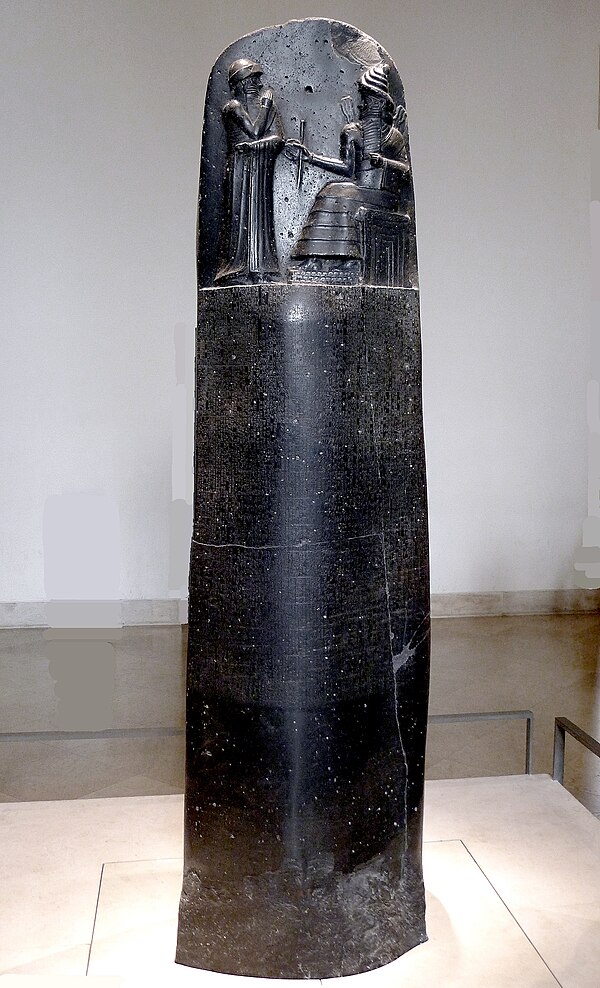
Here it is. The famous Code of Hammurabi.
Before we look at it, two things that confuse a lot of people.
First: it's not a book.
As you can see, it's a stone stele.
Second: it is not the first legal code in history. That title belongs to the Code of Ur-Nammu, which is earlier. Hammurabi's is the most famous — but not the first
Now let's take a look.
Hammurabi was the sixth king of the First Dynasty of Babylon, about 3,800 years ago. As his kingdom grew, he needed a way to govern so many people. And the solution was this: put everything in writing.
Look at the top. There are two sculpted figures.
The one on the left is Hammurabi. The one seated on the throne is Shamash, the god of sun.
What you see above his shoulders — is the heat of the sun.
And in his hand he holds a staff.
The staff is a symbol of power.
Shamash is handing it to Hammurabi.
The message is clear: the king rules in the name of the gods.
And just below the two figures you'll see a series of inscriptions.
That's cuneiform writing.
Come closer and have a good look.
What do you make of them?
Drawings? Hieroglyphics?
That's normal — cuneiform started as pictographic writing, just like Chinese characters.
The sun, the moon, a bird, a fish... Over time it became phonetic writing.
For centuries nobody could read it. Until 1802, when a German high school teacher named Grotefend found the key to deciphering cuneiform — almost by accident, on a bet with a friend.
Then other researchers completed the work. And today we know exactly what it says here.
There are 282 laws.
And if you had to sum them up in one phrase, it would be this: an eye for an eye, a tooth for a tooth. Hammurabi starts by introducing himself. "I am the sun of Babylon, the all-powerful king."
Interesting, isn't it?
Egyptian pharaohs also called themselves "Ra," the God of Sun. Louis XIV called himself the Sun King.
The sun as a symbol of power — and it all starts here, in Mesopotamia. Then come the laws.
Article 22: if someone steals, the penalty is death.
Article 195: if a son strikes his father, his hand is cut off.
Some problems aren't so new after all.
Articles 196 and 200 literally say this:
"If a free man damages the eye of another free man, his eye shall also be damaged. If a free man breaks the tooth of another free man, his tooth shall also be broken."
An eye for an eye, a tooth for a tooth. Literally.
But there are nuances. The laws change depending on your social status.
"Free man" here means noble.
"Not free" means slave.
If a noble broke a slave's tooth, the noble's tooth wasn't broken — he paid financial compensation.
Inequality was part of the system.
And since Mesopotamia was a commercial civilization, there are very strict laws around trade. Making a transaction without witnesses or a written contract was considered theft. Penalty: death.
And there’s one that I find fascinating. If a tavern keeper watered down the wine to sell it for a higher price, the penalty was to be drowned in his own barrel. There are laws from 3,800 years ago that could still be applied today.
Take all the time you need. When you're ready, we'll move on.