The Dying Slave
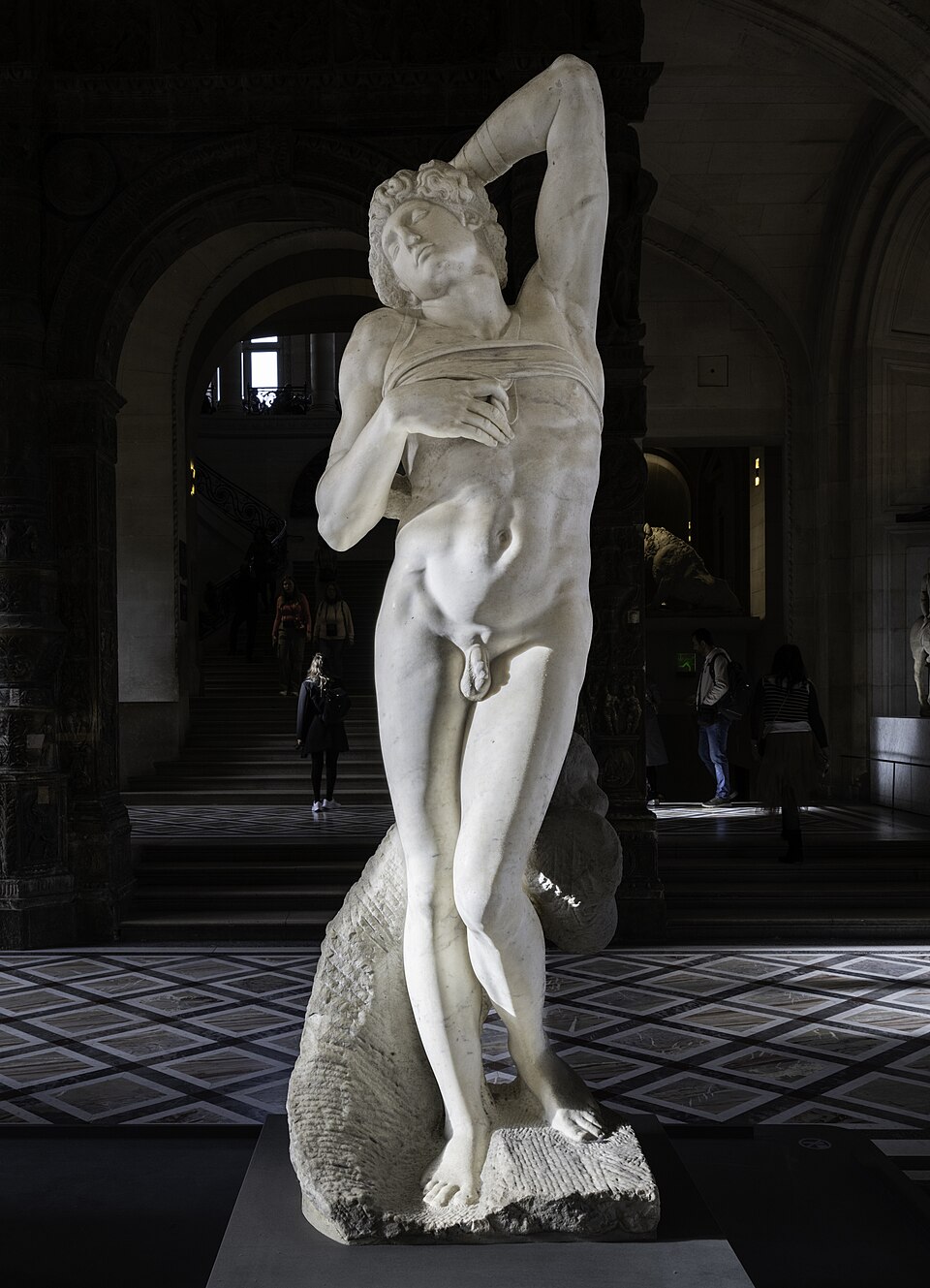
These two sculptures are by Michelangelo.
Both depict slaves. And each has a different meaning — one is life, the other is death.
Before I explain which is which, you choose.
Which do you think represents death?
The left one or the right one.
Most people say the one on the left is death — it looks like it's struggling not to die.
And that the one on the right is life — it looks like it's sleeping peacefully.
It's the opposite.
The one on the left is life.
It's struggling to free itself from slavery in order to truly live. That's why it's called the Rebellious Slave.
The one on the right is death. It's not sleeping. It's dying. And in that death it finally finds the freedom it never had in life. That's why it's called the Dying Slave.
Now look at the materials.
The Dying Slave is made of high-quality marble.
The surface is smooth, almost silky.
The Rebellious Slave has cracks.
Michelangelo couldn't find the marble he wanted for this sculpture and had to work with one that was already cracked.
The surface is also rougher.
For a long time it was thought to be unfinished. Today some believe Michelangelo left it that way on purpose.
But since he never explained it, we can only speculate.
Why did he make them?
Pope Julius II — the same one who commissioned the Sistine Chapel — asked Michelangelo to sculpt figures to decorate his tomb.
But Julius II died before the sculptures were finished.
And the tomb project was scaled back — there was no longer space for these figures.
Michelangelo gave them as a gift to Roberto Strozzi, of the Strozzi family of Florence.
When the Strozzis fell out of favor with the Medicis, they fled to France — and took the sculptures with them. In France they sold them to Cardinal Richelieu.
Over time they became property of the French State. And here they are.
Michelangelo made four other slave sculptures. Those are clearly unfinished.
And they're in the Galleria dell'Accademia in Florence —
the same museum where the David is.
If you go to Florence, don't miss it.