The Wedding Feast at Cana
In the late Renaissance, the center of art moved beyond Florence and Rome to Venice.
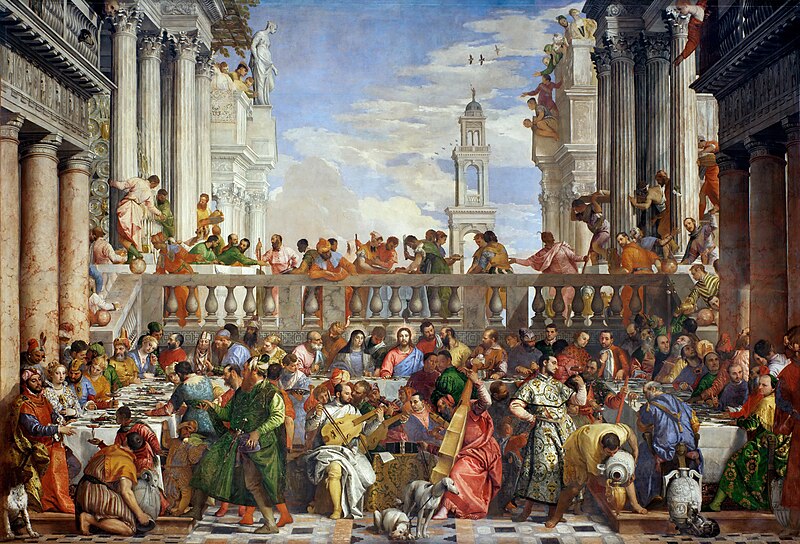
This painting is by Paolo Veronese, one of the great Venetian masters. It's called The Wedding at Cana.
In the late Renaissance, storytelling emerged, and the expressions and atmosphere of the characters came to life.
Shall we take a look at the painting?
The scale of the painting is immense, isn't it?
it's the largest painting in the Louvre.
It was originally in the church of San Giorgio Maggiore, in Venice. Napoleon took it during his campaign in Italy.
The painting depicts the first miracle of Jesus as recorded in the Bible.
What is the story about?
At a wedding in a small village called Cana, the wine prepared by the couple runs out. Seeing that there is no more drink for the guests, Mary asks her son Jesus for help.
Jesus orders the servants to fill six stone jars with water. And the water turns into wine.
Now find the scene in the painting.
In the bottom right corner, a servant in a yellow robe is pouring water from a white pitcher into a golden vessel. But what comes out isn't water — it’s red wine
To his right, a man in blue clothing has noticed and is looking on in astonishment.
And to his left there's a wine steward tasting the wine with a look of surprise. It didn't just turn into wine — it's better than what they had before.
Now look at the center of the painting.
Who's sitting in the place of honor?
Not the bride and groom.
It's Jesus.
To his left is Mary. And around him, his disciples.
As you can see, the clothing of Jesus, Mary, and the disciples reflects the style and atmosphere of the era when Jesus lived. In contrast, the background and the other characters shown have a more sophisticated appearance.
This is because the background of the painting portrays Venice as it was during the artist’s own time.
Cana was a small, humble village. But Veronese painted it with the grandeur of Venice.
Furthermore, Veronese also painted something that does not appear in the Bible.
See the musicians in the center? They don't appear in the Bible.
Veronese added them. They are him and his friends.
The one in white clothing is Veronese.
The one with the turban playing the flute is Bassano. The one in purple clothing with the violin is Tintoretto.
And the one in red clothing with the double bass is Titian.
Putting their own faces in a religious painting would have been unthinkable in other cities. But Venice gave its artists a freedom that didn't exist elsewhere.
Now, look at the painting again, it's a wedding, isn't it?
Surely the bride and groom must be sitting somewhere.
Where could they be?
Yes, that's right.
Those two people sitting in the left corner are the bride and groom.
There are two reasons why we can say that those two sitting in the left corner are the couple.
First, by their clothes — they are the best-dressed people here.
Second, look at their faces. It's their own wedding, yet they look so worried.
Because the wine has run out.
And look at the man standing next to the bride. Blue clothing, unkempt beard. He's being very persistent with her.
He's not just any guest — he's the French king Francis I.
The same one who went to war with Italy and took Da Vinci to France. For Italians, a detestable king. And Veronese knew it. He painted him that way on purpose.
Before we move on, there are three hidden details that symbolize the death of Jesus.
First: right above Jesus's head, slightly to the right, there's a black jar tilted.
It symbolizes the blood Jesus will shed.
Second: above that jar, a man and a woman are cutting meat with a knife.
It's lamb meat. Jesus is the Lamb of God — the one who will be sacrificed on the cross.
Third: among the musicians there's a table.
On top of it, an hourglass.
Jesus's time is running out.
Interesting, isn't it?
And regarding this painting, I mentioned that Napoleon took it as loot.
At that time, there were many other things he took besides this one.
That is why Italy demanded the return of the looted artworks and formed a negotiation team led by the famous sculptor Antonio Canova. They negotiated with France and managed to recover many of them, but with this piece, Denon, the first director of the Louvre, played a trick.
He hid this painting so they couldn't take it back, which is why it remains here to this day.