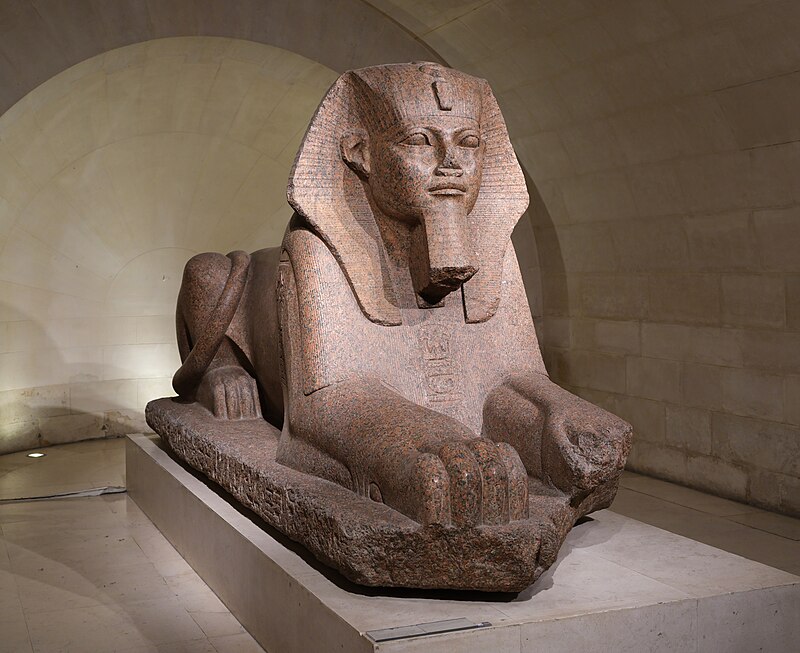
Great Sphinx of Tanis
Transcript
Here's what your guide tells you about this work in the MuseCat app.
The Sphinx. Along with the pyramids, it's the most recognizable symbol of Egypt. In Greek mythology, the sphinx was a monster that devoured people. But in real Egypt it was the exact opposite: a sacred guardian. You'll find them at the entrances to palaces, temples, and in front of the pyramids... And take a look: this one has the face of a pharaoh and the body of a lion.
We don't know which king it represents. It hasn't been deciphered yet. But we know it's a pharaoh. There are three clues. First: look at the forehead. Can you see something protruding slightly? It's broken, but originally there was a cobra there, the uraeus. In Egypt, the cobra was a symbol of royal power.
Second: the striped headdress on its head. It's called a nemes. It was exclusive to pharaohs. Third: there are hieroglyphics on the chest. It's a cartouche, an inscription reserved for referring to the pharaoh. With these three things, we know it's a pharaoh. Even if we don't know which one.
This sphinx was found at Tanis, in the Nile Delta. It came to the Louvre in 1826, bought from the collection of the British consul Henry Salt on the advice of Champollion. But Europe's hunger for Egyptian antiquities had begun a few decades earlier.. When Napoleon went to Egypt with his army, he also brought French archaeologists. Their mission was to study Egypt, and they collected many pieces to bring back to France! At the time, there was no legal framework protecting these objects, and European powers moved fast. They were abandoned, unprotected. And excavation permits were granted without question. That's how the great Egyptian pieces ended up in France, in England, in the great European museums.
Starting in the second half of the 19th century, Egypt began to understand what it had. It banned the export of pieces and has been asking for them back for decades. It's a story that isn't unique to Egypt. Many countries experienced something similar.