Liberty Leading the People
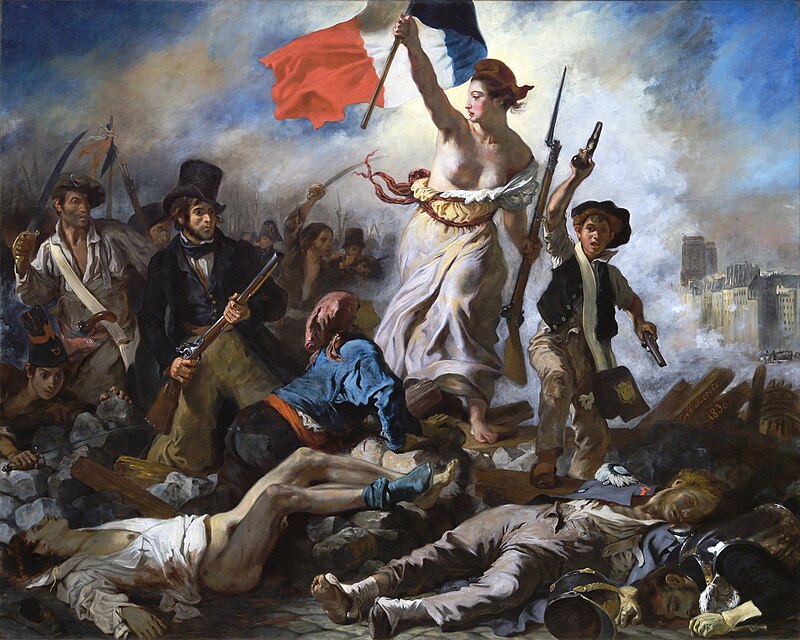
This painting is called Liberty Leading the People, by Eugène Delacroix.
Many people think it depicts the French Revolution of 1789. It doesn't. It's the July Revolution of 1830 — three days that changed France.
And the woman in the center with the tricolor flag. Many people think she's Joan of Arc. Also wrong.
She's Marianne — the goddess of French freedom.
Why Marianne? Back then, the two most common women's names in France were Marie and Anne. They combined them: Marianne.
And she became the symbol of the Republic.
If you've seen France's official coat of arms,
the face in the center of the tricolor flag is hers.
Below, the words: liberté, égalité, fraternité. Liberty, equality, fraternity.
Look at the robe. It is not a nineteenth-century dress
it looks like a tunic from ancient Greece.
And her chest is bare.
Delacroix painted her based on Libertas, the Roman goddess of freedom.
Years later, that same image inspired the Statue of Liberty in New York.
Where did Delacroix find inspiration for this figure? From a real woman.
A washerwoman who left everything to join the revolution. Her younger brother had been killed by government troops.
She went out to fight.
And she died in combat !
Look at the hat Marianne is wearing. It's the Phrygian cap — the one slaves in Rome wore when they regained their freedom.
A symbol that goes way back.
In her hand, the tricolor flag of the French Revolution.
And there are two more places in the painting where the tricolor flag appears.
See if you can find them.
The first: the man with the headscarf, just below Marianne. His shirt has the three colors — red, white, and blue.
The second is very hard to see. On the buildings on the right, at the top of Notre-Dame, there's a tricolor flag. Almost invisible.
The revolution of 1830 ended with King Charles X. The Parisians took the city,
the king was dethroned and sent into exile.
When the painting was exhibited, the criticism was harsh.
"A goddess has to be beautiful — this woman is dirty, disheveled." It didn't fit the standards of beauty the art world accepted at the time.
But the new revolutionary government bought it and hung it in the royal palace.
However, the new king, Louis-Philippe, turned out to be just as repressive as the previous one. And one day, quietly, he took the painting down and put it in a storeroom. It stayed there for years. Until 1874, when it saw the light again. And it's been here ever since.