Venus de Milo
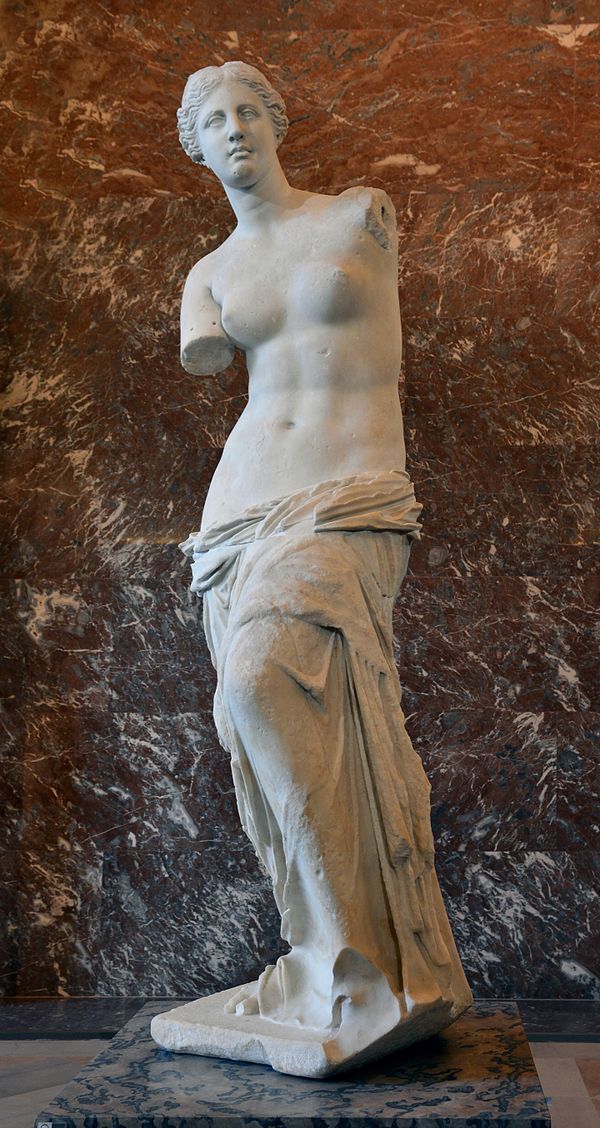
This is the Venus de Milo.
One of the most famous sculptures in the world. And we don't know who made it. Not the sculptor's name, nor the exact period.
The name comes from where it was found — the Greek island of Milos.
In 1820, a farmer was working the land when something caught his tool. It was this!
When they found it, the torso and the lower part were separated. But the arms were intact!
The farmer sensed it was worth something.
He showed it to a French diplomat who happened to be in the area.
The diplomat saw it and bought it on the spot.
A year later he offered it to King Louis XVIII.
And it's been here ever since.
When it arrived in France, it caused a sensation. For three reasons
The first has to do with another sculpture.
Before the Venus de Milo, the great Greco-Roman reference at the Louvre was the Laocoön. Do you know it?
Napoleon brought it from Italy as war plunder. But when his regime fell, the looted pieces had to be returned. The Laocoön went back to Italy — it's in the Vatican today.
And the Venus arrived just in time to fill that gap. The French experienced it as a gift from fate.
The second reason was the golden ratio.
It was said this sculpture had the perfect proportion: 1 to 1.618 — the golden ratio.
Today we know the actual proportion of the Venus is 1 to 1.555. And we also know the claims about credit cards or iPads having the golden ratio are false. But at the time, nobody questioned it.
People wanted to see with their own eyes an ancient work with that mythical proportion.
And the third reason — the arms. When it was found, the arms were there. But they were lost during transport to France.
The Louvre wanted to restore them, but came to a conclusion: without arms, the curve of the body is better seen. And besides, it forces you to imagine. What would those arms have looked like?
Experts have their theories. The right arm — look at where it's broken and how the hip tilts — probably held the draped cloth that falls. The left — notice how the left shoulder rises — perhaps held a golden apple, the symbol of Venus.
Okay, that's enough on Venus — take a photo with her if you want, and then we'll head over to see the Winged Victory.