The Coronation of Napoleon
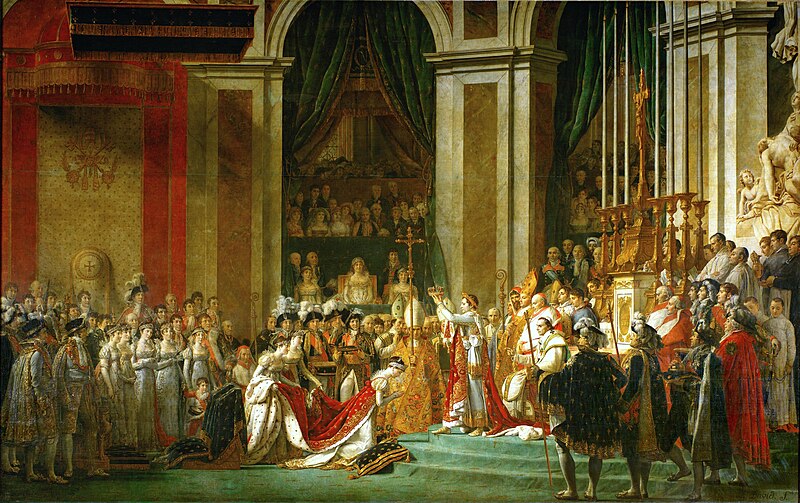
This painting is The Coronation of Napoleon, by Jacques-Louis David.
The ceremony took place on December 2, 1804. And the painting was painted between 1806 and 1808 — two years after the event
Since the coronation was such a significant event, all the important figures of the time attended.
Therefore, many key individuals appear in the painting.
Look at Napoleon in the center. The clothing he's wearing is no accident. He's dressed like the Roman emperors. That day he was already saying something: I want to build an empire like Caesar's.
In front of him, Empress Joséphine is kneeling, about to receive the crown.
Behind, Pope Pius VII is raising two fingers — the gesture of blessing.
And between Napoleon and Joséphine, the man with the cross is the Bishop of Notre-Dame, where the ceremony was held.
Napoleon chose Notre-Dame on purpose.
French coronations were traditionally held in another church — but Napoleon considered it too small. Notre-Dame was larger. More imposing.
Now, the key moment. In a traditional coronation, the king kneels and the Pope places the crown. That's the culmination.
But here the king is standing. And the Pope is seated behind.
Because that's what happened that day.
Napoleon picked up his own crown and put it on himself.
Then he picked up Joséphine's crown and placed it on her too.
The Pope crowned nobody. He sat there watching.
The message was clear: I am more powerful than the Pope!
And he wanted that message immortalized in a painting.
David painted it exactly that way. He wanted to earn Napoleon's favor. And he succeeded — in the painting,
the Pope doesn't look displeased at all.
But many things in this painting didn't actually happen.
Look at the upper balcony, right above Joséphine. There's a woman seated, watching the scene with satisfaction. She's Napoleon's mother.
But she wasn't there that day. She didn't go to the coronation.
Why? Napoleon had banished his brother Lucien for marrying without his approval. And his mother, in solidarity with Lucien, decided not to go.
And there's another person Napoleon's mother couldn't stand. Her daughter-in-law — Joséphine.
It's known that Letizia strongly opposed Napoleon's relationship with Joséphine.
The main reason: Joséphine was five years older than her son.
In the painting, David painted her as if she were twenty. Reality: she was forty, Napoleon was thirty-five!
Behind Joséphine there are five women.
The three on the left are Napoleon's sisters.
As for Napoleon and Joséphine — at first they were happy. But Joséphine could never give him an heir. And that ended up being the end of their marriage.
Now look for the white-haired man between Napoleon and the Pope. That's Julius Caesar.
The historical figure Napoleon admired most. They lived in completely different eras. But David painted him there anyway.
It's said that David told Napoleon: "Even the man you most admire envies you." Pure flattery.
And David slipped himself into the painting.
Look at the balcony just above Napoleon's mother's, on the left. There's a man drawing. That's David.
He didn't actually paint the picture there. He did it in his studio,
first finding out where each person was, then using life-size cardboard figures to calculate the proportions. One by one.
From that enormous effort, this work was born.
This painting has a twin. There's an identical version at the Palace of Versailles.
With just one difference: the dress of one of Napoleon's sisters — the second from the left — is pink in the Versailles version.
It's said that David was in love with her and painted her in pink to express his feelings.
After Napoleon's fall, David fled to Brussels. There he continued painting portraits for the nobility until he died at seventy-seven.
As a person, his track record is hard to admire. But as a painter, he was the best in 19th-century France. And this painting proves it.