The Raft of the Medusa
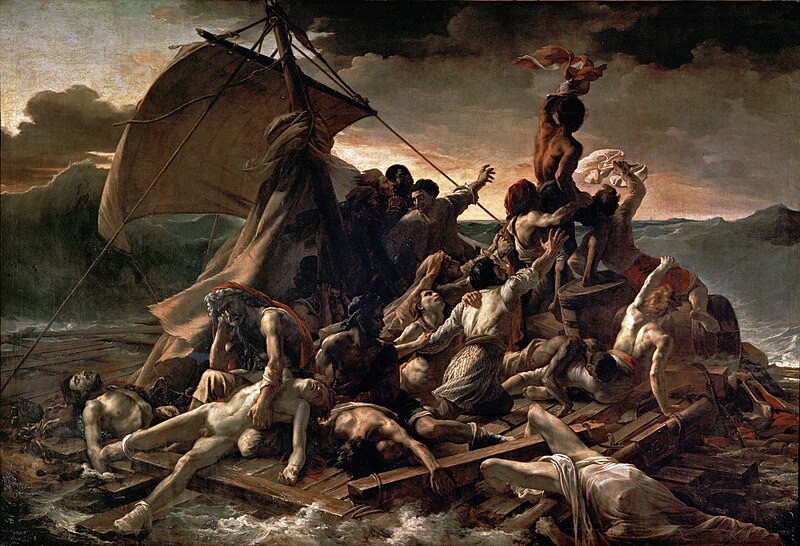
This painting is called The Raft of the Medusa, by Théodore Géricault.
Géricault was born in 1791 and died in 1824. He was thirty-three years old.
He died from injuries after falling from a horse.
With so much left to paint.
The painting is based on a real event — the shipwreck of the frigate Medusa in 1817. He painted it the following year, in 1818.
What you see is the raft after the shipwreck.
To understand what you're seeing, you need to know the story.
The Medusa was a ship traveling from France to Senegal.
The goal was to colonize Senegal.
France had been lagging behind Portugal, Spain, and England in the colonial race.
The captain of the ship was named Chaumareys. He had no experience commanding a ship of that size. But he was a noble, from a royalist family, and used his connections to get the position.
And since he had spent a lot of money on this, he needed to recover it
so he crammed four hundred people onto a ship with capacity for three hundred and twenty-six.
He ignored the crew's warnings, pushed the speed, and the ship ran aground on a reef.
What came next was worse.
Chaumareys filled the lifeboats with the highest-ranking passengers.
The rest — a hundred and ninety-five people — were put on an improvised raft made from the ship's timbers!
And when the raft started slowing down their progress, they cut the rope and abandoned them.
No food. No water. Days later they started killing each other. And eating each other.
When the raft was found fifteen days later, of the hundred and fifty-nine people remaining, only fifteen were still alive.
Five died shortly after. In the end, ten survived.
The French government tried to cover it up. They didn't succeed.
A survivor wrote a book. And Géricault read it, spoke with the survivors, and painted this painting.
Now look at the painting. On the right there's a man with his left arm raised.
To his left, on the ground, a dead Black man, face down.
And between his right arm and the raft — look carefully — there's an axe.
With blood on it.
That's what happened on that raft.
The lower part is full of bodies. It's death.
On the left, an old man with white hair is holding a corpse to keep it from falling into the water.
It's his son.
He's in shock. His gaze lost, his body without strength.
Now look upward. In the center and upper part, the people are alive, agitated, full of hope.
They're looking at something.
On the right, almost invisible, there's a ship approaching. So small it's barely visible. They're waving whatever they can to be noticed.
Géricault didn't just paint the horror. He also painted hope. That tiny ship on the horizon is the new world to be reached. Géricault didn't just portray what happened. Through this painting he also tells us where we should be heading.
And eleven years after this painting, in 1830, the French Bourbon monarchy fell. As if the painting had announced it.
To paint this, Géricault didn't stay in his studio.
He got on a real raft and rowed, to study the movement of the water and the waves. That's what you see here — it's not imagination, it's observation. Can you tell?