Paris · Palace & Rooms
The Coronation Room - The Oath of the Army after Receiving the Eagle Standards, and the Divorce
Palace of Versailles · Paris, France
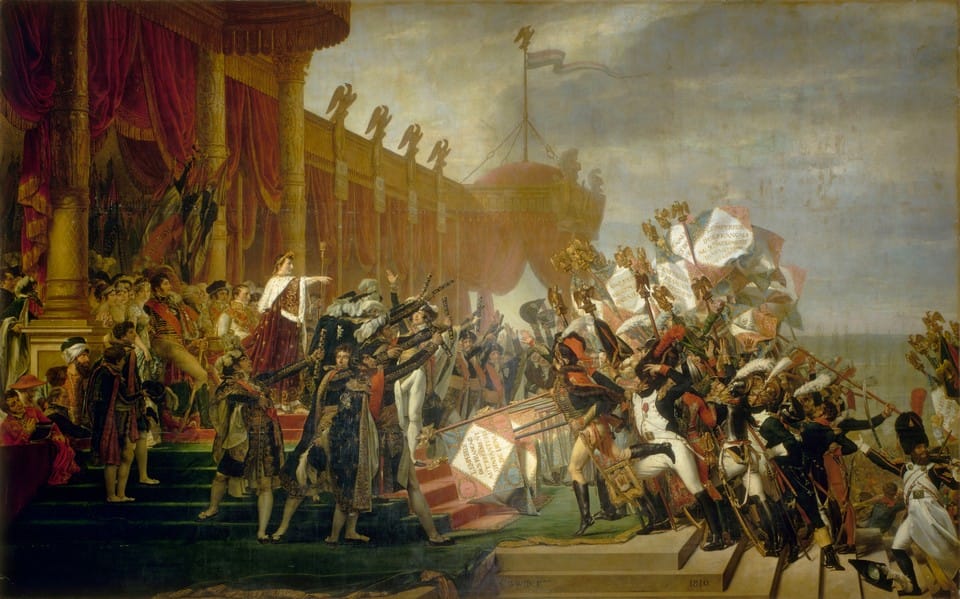
This painting depicts another official ceremony, held three days after the coronation, on December 5, 1804. Napoleon had replaced the French army's emblem with the Roman-style eagle, and the painting shows him distributing eagle-crested standards to each regiment while the soldiers cheer. This painting, too, originally included Empress Joséphine, just as the painting opposite it did — but she is nowhere to be seen today. A year before the work was finished, Napoleon and Joséphine divorced, and David, still in the midst of painting, was forced to hastily erase her. To fill the gap she left, he reworked her son, Eugène de Beauharnais, extending one of his legs forward — a detail that, once you know the story, can make his pose look slightly awkward.
Napoleon and Joséphine divorced because they had no heir. Joséphine had a son from her first marriage but bore Napoleon no children. After their separation, Napoleon remarried Marie-Louise, with whom he had a son. This room holds a portrait of Marie-Louise facing one of Joséphine, along with paintings of Napoleon both as a young officer and later as emperor. The enormous painting covering the opposite wall depicts the Battle of Aboukir, a French victory — the only painting in the room to convey the urgency of an actual battlefield, underscoring that Napoleon was a military hero well before he became emperor. At the center of the room stands a porcelain column commemorating the Battle of Austerlitz, Napoleon's greatest victory and the one that made France the dominant power in Europe. Its shaft depicts the army's march, scenes of battle, and the victorious soldiers, crowned at the top by a statue of the goddess of victory.