Paris · Palace & Rooms
The Coronation Room - The Coronation Painting
Palace of Versailles · Paris, France
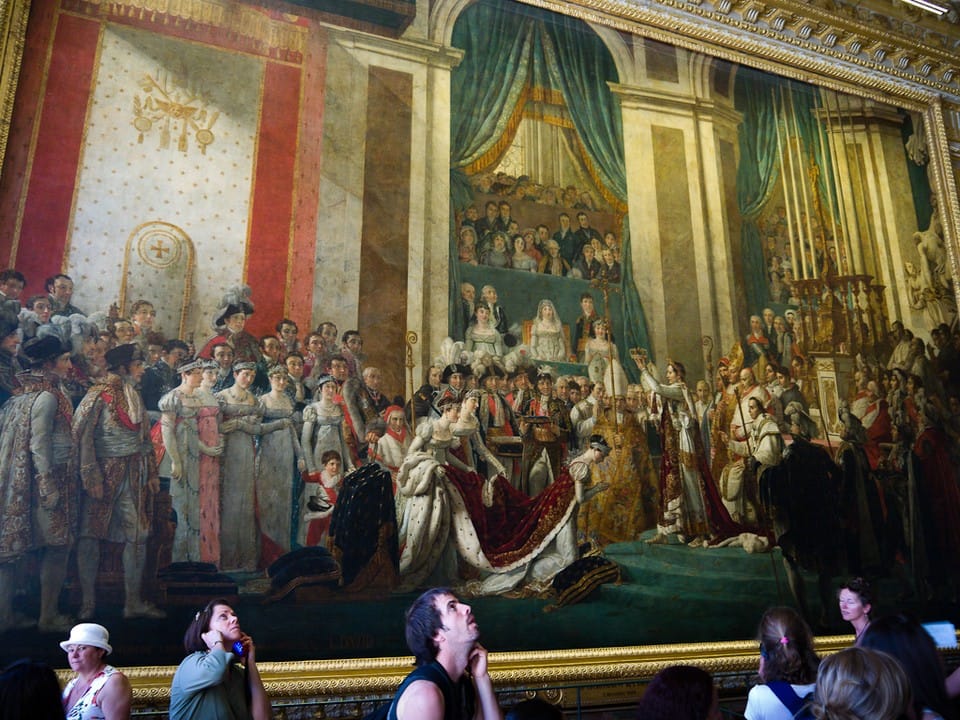
This painting, which fills an entire wall, depicts the coronation of Napoleon. Before an audience of clergy and nobles, Napoleon is shown placing a crown on Empress Joséphine. The scene, however, is staged rather than a literal record of events. At a typical coronation of the era, the Pope crowned the monarch to signify that power came from God — but Napoleon broke with tradition, placing the crown on his own head with his own hands. It was a declaration that he, not God or the Church, had made himself emperor. That moment, though, was entirely omitted from the painting, since depicting Napoleon disregarding the Pope risked appearing arrogant to other European monarchs and could prove diplomatically damaging. Instead, the finished painting shows Napoleon crowning his wife while the Pope raises a hand in blessing — a far gentler scene.
At the center of the painting sits Napoleon's mother, Letizia, who likewise was absent from the actual ceremony due to a family rift. Even so, Napoleon instructed the painter: "Put my mother in. The public doesn't need to know our family isn't close." And so she was painted in, elegant and central. When she later saw the finished work, she reportedly responded with cold irony: "It's rather absurd, since the whole world knows I wasn't there."
This particular canvas is not the original, though it is no forgery either — it is a second version painted by the same artist, Jacques-Louis David. The first hangs today in the Louvre. The two are nearly identical, but one difference stands out: among the women on the left, a single figure wears a pink dress. When painting a duplicate, artists traditionally introduce small variations as a kind of signature proving the second work is a new painting rather than a mere copy. The woman in pink is Pauline Bonaparte, Napoleon's sister, reputed to be one of the great beauties of Europe at the time; David, who admired her looks, rendered her even more striking in this second version. David himself also appears in the painting, sketching among the crowd of onlookers.
David painted the work a second time for money. After Napoleon's fall, David, as his former court painter, was exiled to Belgium, his assets seized and his income gone. In his later years, American businessmen offered him a substantial sum to paint them a version of his famous coronation scene. At the same time, France's restored monarchy was working to erase Napoleon's legacy, and David likely also wanted to preserve and share his patron's most glorious moment with the world. How he managed to reproduce the composition so faithfully — exiled from France, unable to see the original, and working fifteen years after he first painted it — came down to his talent: the composition was etched in his memory, and he had kept his detailed sketches of the individual figures to work from.