Paris · Palace & Rooms
Louis-Philippe, the Citizen King, and the Art of Trompe-l'œil
Palace of Versailles · Paris, France
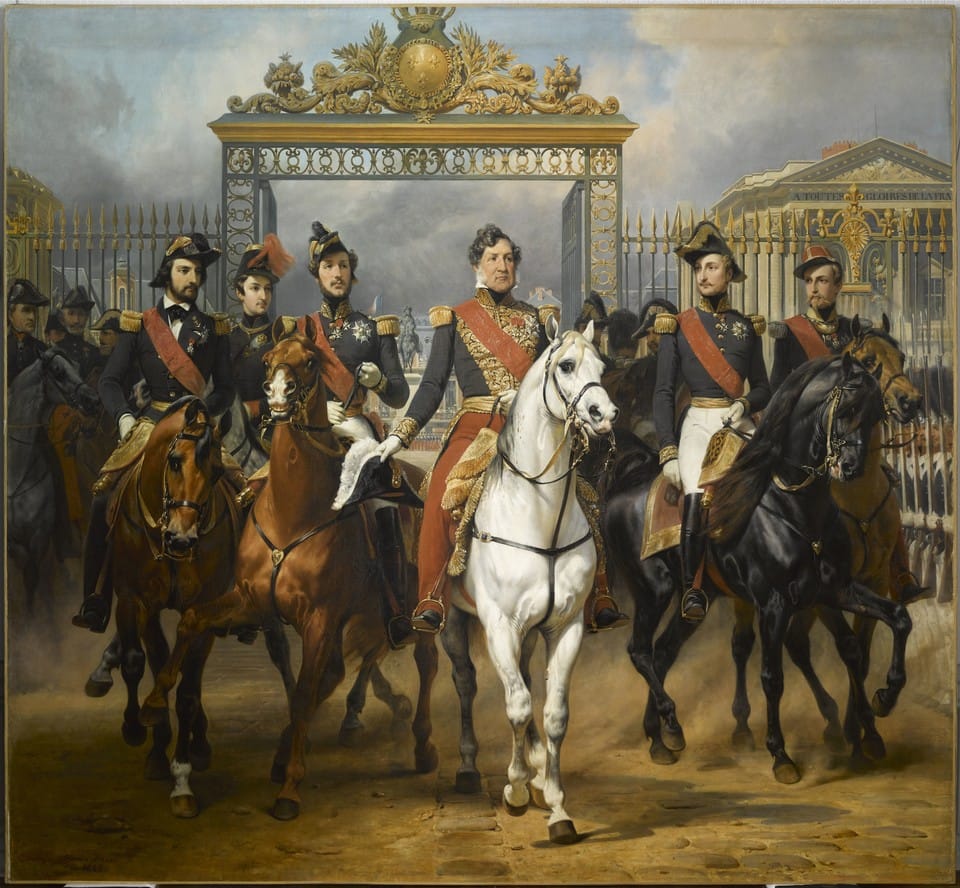
At the center of the largest painting here, the figure on the white horse is Louis-Philippe, shown with his five sons in front of the Palace of Versailles. Crowned after the July Revolution of 1830 and known as the "Citizen King," he had no interest in living at Versailles himself; instead, he converted it into the Museum of French History. Under the slogan "a museum dedicated to all the glories of France," he filled the palace with works depicting key figures and moments from French royal history. This room, for instance, holds a portrait of Charles VII, who led France to victory in the Hundred Years' War, alongside one of Philip II, who served as regent during Louis XV's minority.
Look closely at the two portraits and you'll notice something curious: what looks like a painting set inside a frame is, in fact, entirely painted — frame included. This technique is called trompe-l'œil, French for "deceives the eye," designed to trick viewers into mistaking a painted image for a real object. It let artists create a lavish visual effect without using actual marble or sculpture — a fitting reflection of Louis-Philippe's own preference for maximum impact at a reasonable cost, rather than extravagance for its own sake.