Paris · Architecture
A Storm of Light and a Map of the Space
Sainte-Chapelle · Paris, France

You've made it up the narrow stairs, and the sight that greets you in the Upper Chapel will leave you speechless. Just stand still and take it in slowly. For 800 years, everyone who has come here has let out the same gasp of wonder you just did.
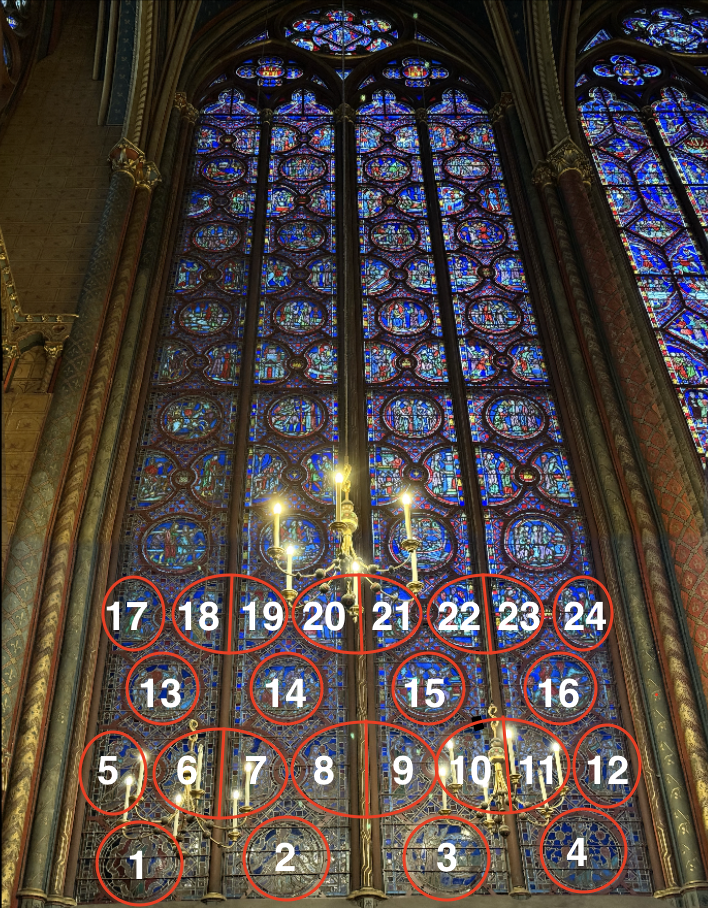
There are no walls, only stained glass on every side. Columns of glass, made of light, soar upwards like a forest of light. Blue is the strongest colour, with red running through it like veins, and depending on where the sun falls, touches of yellow, green and purple come alive.
There are 15 windows in all. The largest is 15 metres high, the height of a five-storey apartment block, and 4.7 metres wide, about 5. Together they hold 1,113 scenes, every letter and every scene painted by hand. Two-thirds of them survive from the 13th century. These windows move and come alive with time: in the morning the eastern windows awaken, at noon all the windows overhead, and in the afternoon the western rose window. Colours differ between cloudy and clear days, between summer and winter, and even change from hour to hour on the same day. The colours before you now exist only once in the world, just for you.
Let's map out the whole space. Step into the middle of the aisle and look straight ahead: at the far end is a semicircular space. That is the east, where the altar stood, and 800 years ago the Crown of Thorns was kept there inside the Grande Châsse.
Facing forward, let's divide the space into zones. The semicircular eastern end is called the apse. Seven windows curve around it, each about 2.1 metres wide and 13.5 metres high, narrower than the others. The most important, in the centre, is Window 0, which tells the Passion of Christ, with three windows stretching away on either side.
As you face forward, left is north and right is south. Each side has four windows, eight in all, the largest ones: 4.7 metres wide and 15.35 metres high, almost five storeys. They are picture books.
Look at the left, north wall. The first large window nearest the entrance, where you came up the narrow stairs, is Window 13: Genesis. Next is Window 11, Exodus, then Window 9, Numbers, and the last, closest to the window ahead of us, covers Deuteronomy and Joshua. The first five books of the Old Testament, the Pentateuch, and what comes right after them flow in chronological order from the entrance inwards. It runs from the beginning of humanity towards the Passion of Christ.
On the right, south wall, the first large window nearest the entrance is Window 14, the history of the relics. Then comes Window 12, Kings, Window 10, Esther, and the innermost one, closest to the front, covers Judith and Job. That one is currently covered because of building work. Window 14 is, in a sense, the climax and the most important of them.
Behind you, above the entrance, is a large round window, the western rose window. While the others date from the 13th century, this rose window alone was remade 200 years later, in the 15th century, and its theme is the Book of Revelation, the end of the world.
To sum up: the western rose window by the entrance shows the end of the world, Revelation; the eight large side windows show the beginning of the world, the Old Testament, and Louis IX's own history; and Window 0 in the centre of the eastern apse shows the Passion of Jesus. Next, let's learn how to read this stained glass, step by step.