Paris · Architecture
The Assassination Attempt Behind Palais Garnier
Palais Garnier · Paris, France
Palais Garnier, built in 1875, is a storied national opera house. But France already had a national opera house before it: the Salle Le Peletier, on Rue Le Peletier. From 1821 to 1873, for about 50 years, it was the hottest place in town, where Parisian high society and artists gathered for ballet performances and balls.
You may have seen the ballet paintings of the Impressionist Edgar Degas. About half of the roughly 3,000 works he painted over his lifetime are said to show ballet, and the dancers rehearsing and performing in them were at the old national opera house, the Salle Le Peletier. The painting on your screen is also by Degas and shows Jules Perrot, the leading choreographer of his day, teaching a ballet class. One of Perrot's best-known works is the ballet Giselle, the story of a country girl who falls in hopeless love with a count named Albert. It premiered at the Salle Le Peletier.
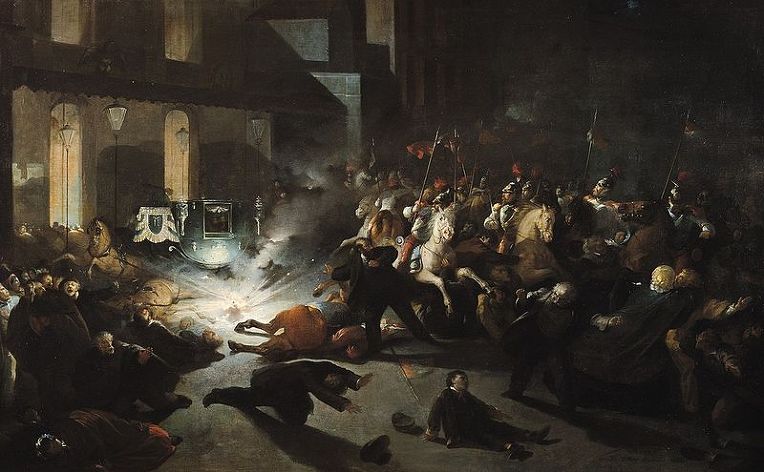
So why did Napoleon III, then Emperor of France, decide to build a new opera house when he already had a perfectly good one? It all goes back to a late evening on January 14, 1858, outside the Salle Le Peletier. That night, Napoleon III and the empress had just arrived by carriage to attend an opera singer's farewell performance when three explosions rang out. A bomb had gone off in front of the carriage. Shrapnel flew, the blast threw people off their feet, and the street dissolved into chaos. Eight people were killed and more than 100 were injured, while the imperial couple are said to have survived thanks to the carriage's special steel plating. In the painting of the scene, the moment of the blast appears as a bright glowing object at the center.
The man behind the plot was Felice Orsini, an Italian revolutionary. He was furious that Napoleon III, one of the most powerful figures in Europe, had not helped Italy win independence and unification; at the time Italy was split into small states under Austrian rule. Orsini built bombs, hoping to assassinate the emperor and spark an Italian independence revolution. The plan failed, and he was arrested and executed along with his accomplices.
After the attack, Napoleon III began looking for a way for the emperor and the upper classes to enjoy the opera in safety. The result was a safer Palais Garnier and the Avenue de l'Opéra.