Paris · Painting
A Portrait of a Six-Year Love: Tissot's A Woman in Reverie
Musée d'Orsay · Paris, France
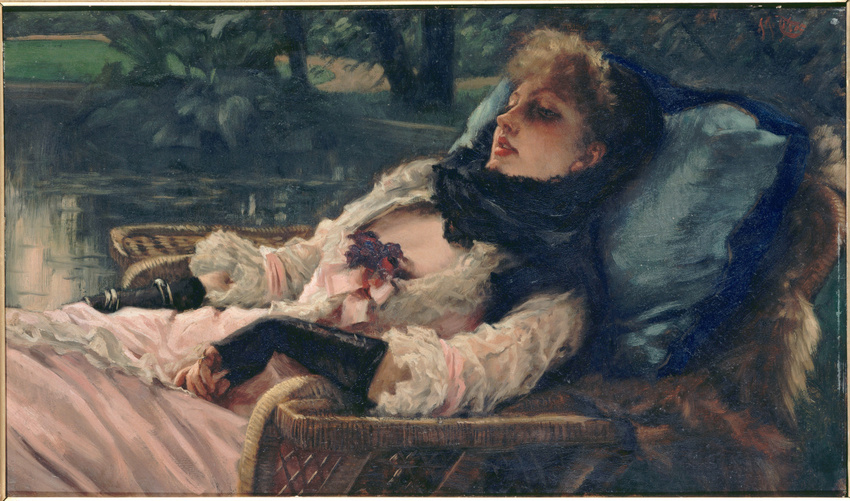
A woman leans against a sofa, gazing off into the distance. Her expression — calm, yet tinged with something lonely and dark — belongs to Kathleen, the woman painter James Tissot loved.
Kathleen was something of a scandal in British society at the time. Married as a teenager to a British official stationed in India, she divorced not long after, then fell in love with a naval officer and had a child with him. In the conservative world of Victorian England, being both a divorcée and an unwed mother was far from a minor stigma.
None of that mattered to Tissot. He fell in love with her, and once back in London, the two began living together as though married, though never formally wed. Tissot had, at the time, built a thriving career painting elegant portraits of Britain's upper class — but once word got out that he was living with Kathleen, his high-society clients began abandoning him one after another. Financially, the fallout was severe, but Tissot later said this was the happiest period of his life. Rather than painting aristocrats for pay, he could paint the woman he loved, as often as he liked.
That happiness, though, didn't last. Kathleen contracted tuberculosis, and her health declined rapidly — a disease that was, at the time, essentially untreatable. All Tissot could do was record what time remained to them through his paintings. This work, too, captures one of Kathleen's final moments, as she slowly faded. Tissot and Kathleen's time together lasted only six years — brief, but intensely lived.
Spending time with this painting, you can feel something beyond a simple portrait — the quiet imprint of a man who loved deeply, slowly emerging through the canvas.