Paris · Painting
A Prostitute, Not a Goddess: Manet's Provocation, Olympia
Musée d'Orsay · Paris, France
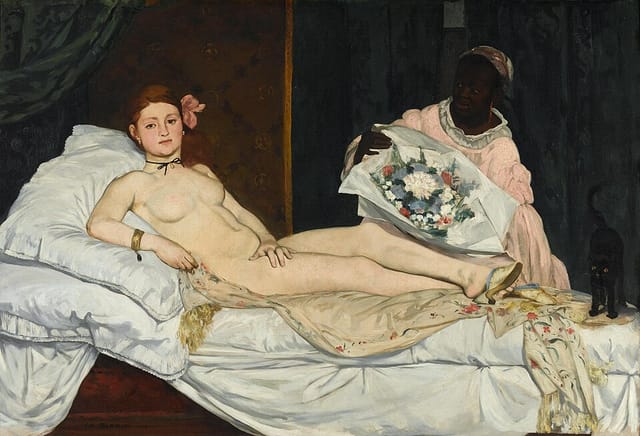
A nude woman reclines on a bed while a Black maid stands beside her, holding a bouquet of freshly delivered flowers. Manet's Olympia was submitted to the same Salon, in the same year, as Cabanel's The Birth of Venus — yet the two paintings met with completely opposite fates. Cabanel's work was celebrated; Manet's was savaged.
There were two main reasons for this. First, Manet painted his nude not as a goddess but as a Parisian prostitute. The ribbon tied around the woman's neck and the bracelet on her wrist were accessories commonly associated with prostitutes of the time, and even the title — Olympia — was one of the most common names prostitutes in Paris used for themselves, borrowed from the character of that name in Alexandre Dumas's wildly popular novel La Dame aux Camélias. Between the accessories and the name, Manet made it unmistakably clear that this woman was no goddess.
Academic painting at the time only permitted female nudity within the context of biblical figures, historical personages, or goddesses from Greek and Roman mythology. In practice, the appeal of these paintings had always been largely voyeuristic — mythology was simply the acceptable wrapper. Looking purely at the composition, Olympia isn't actually all that different from earlier masterworks. Titian's Venus of Urbino, which Manet reportedly used as a reference, shares an almost identical arrangement — a nude woman reclining, a servant standing nearby. When Titian painted his Venus, Venice was a wealthy, commercially driven, culturally open city, also well known for its abundance of courtesans; some even suggest that Titian's model was herself a famous Venetian courtesan. But because that painting was dressed up as a goddess, it raised no eyebrows — the same held true for Cabanel's Venus.
Manet, by contrast, refused to disguise his subject as anything other than what she was. That direct challenge to artistic convention was bound to provoke a backlash, and it did.
The second reason has to do with how the painting exposed an uncomfortable truth about France's bourgeois men. In public, these men postured as refined intellectuals, but in private, keeping mistresses and consorting with prostitutes was commonplace. The Black maid beside Olympia reflects the real social arrangement in which a high-end prostitute, supported by a wealthy bourgeois patron, could afford her own servant, and the expensive jewelry Olympia wears was almost certainly a gift from just such a man. Many of the critics reviewing the painting belonged to that very same bourgeois class, so it's hardly surprising they resented having their own hypocrisy put on public display.
Manet had already drawn criticism once before, for painting an ordinary nude woman in Le Déjeuner sur l'herbe. His decision to push even further with Olympia only deepened the critics' hostility toward an artist who clearly wasn't interested in following their rules.
Still, Manet never let the backlash shake him, and he pursued his own artistic vision to the end. That stubborn independence is part of why some art historians today consider Olympia the true starting point of modern art.