Paris · Visit Tips
Realism in a Glass of Absinthe: Degas's In a Café
Musée d'Orsay · Paris, France
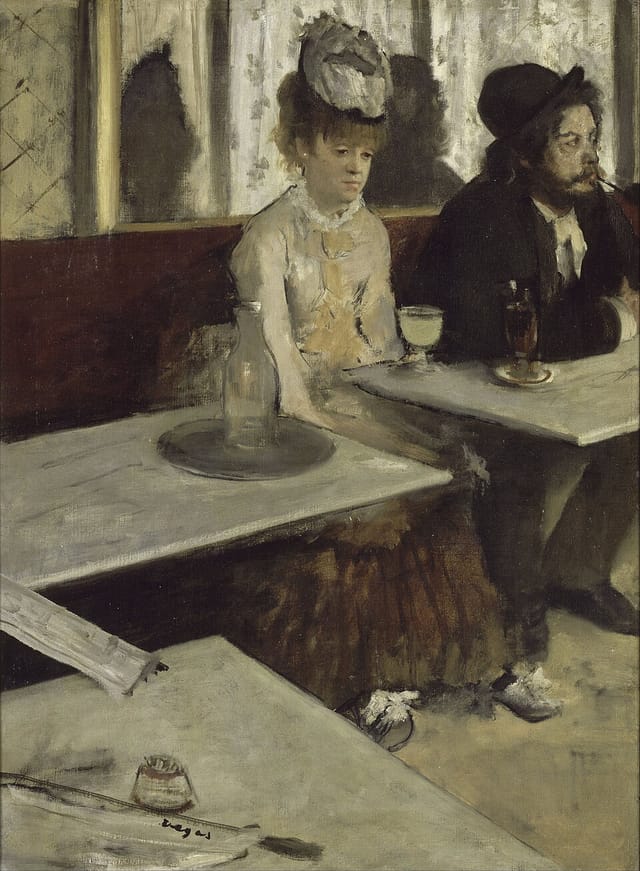
Inside a Paris café, a man and a woman sit at a table. They look like a couple, yet something cold hangs between them. The woman's expression isn't a happy one either. Judging by the angle of the painting, the artist was seated in the same café, painting the pair at an angled table across the room. This kind of composition, almost like a camera catching a single candid moment, is a hallmark of Impressionism. Impressionist paintings were usually made outdoors, but a striking number of Degas's works, including this one, are indoor scenes — because Degas, whose eyesight was poor, deliberately preferred working indoors over outdoors.
On the table in front of the woman sits a single glass containing a drink called absinthe. At the time, this liquor was both extremely cheap and powerful, at around 70 percent alcohol, making it an easy and inexpensive way to get drunk quickly — which is why working-class Parisians favored it so heavily. Absinthe's green tint even gave its name to the "Green Hour," a designated window from 5 to 7 p.m. when Parisians would gather specifically to drink it. That detail alone tells us the figures in this painting belong to the working class. The drink in the glass here isn't green, though — it has a faint milky tint, which is actually remarkably accurate to how absinthe was really consumed. Absinthe starts out green, but drinkers would place a perforated spoon over the glass, set a sugar cube on top, and drip cold water through it to dilute the liquor; once the sugar water mixed in, the drink turned milky, exactly as shown here.
Seventeen years after this painting was completed, it was exhibited in London, and English audiences were deeply shocked by it. Given the title, In a Café, they had expected to see the sophisticated café culture of Paris they so admired — a refined salon where intellectuals gathered to debate ideas. What Degas painted was nothing like that. It captured ordinary Parisians living out ordinary lives, and that gap between expectation and reality is precisely what unsettled British viewers so deeply.