Paris · Painting
André Derain's Hunting Bag
Musée de l'Orangerie · Paris, France
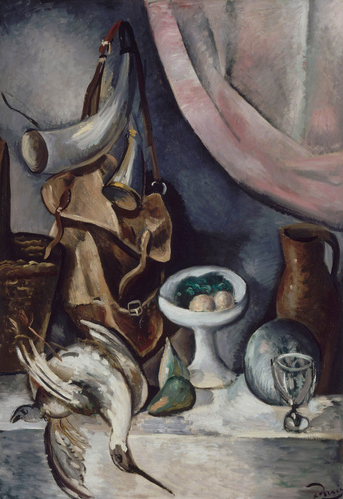
This is André Derain's Hunting Bag. Derain drew inspiration from the still-life paintings of Spanish artists he encountered on a trip to Spain, and on returning to Paris he immersed himself in still-life work — this painting dates from that period. It depicts a hunting bag hanging on a wall, a dead bird lying in front of it, and a pitcher and cup of the kind you'd find on any dining table.
While the subject matter draws on classical tradition, the technique follows the Cubism fashionable at the time. Picasso is usually the first name that comes to mind with Cubism, but Derain, too, was among the painters who helped establish it. Put simply, Cubism breaks objects apart and reassembles them to highlight the beauty of the painting itself — a further step beyond the approach taken by Cézanne. Look at the white bowl beside the hunting bag, for instance: you can see its contents, something that shouldn't be visible from a straight-on view, because Derain has also incorporated a bird's-eye perspective. Blending multiple viewpoints like this, to render a subject as effectively as possible, is the essence of Cubism.
Derain, however, never pushed Cubism to the extremes Picasso did; he adapted its principles to suit his own style, which makes his paintings far easier to take in. Picasso's work, by contrast, can feel genuinely difficult to read, and at the time, that accessibility actually made Derain more popular than Picasso.