Paris · Painting
Which Child Is Jesus? Da Vinci's Virgin of the Rocks
The Virgin of the Rocks · Paris, France
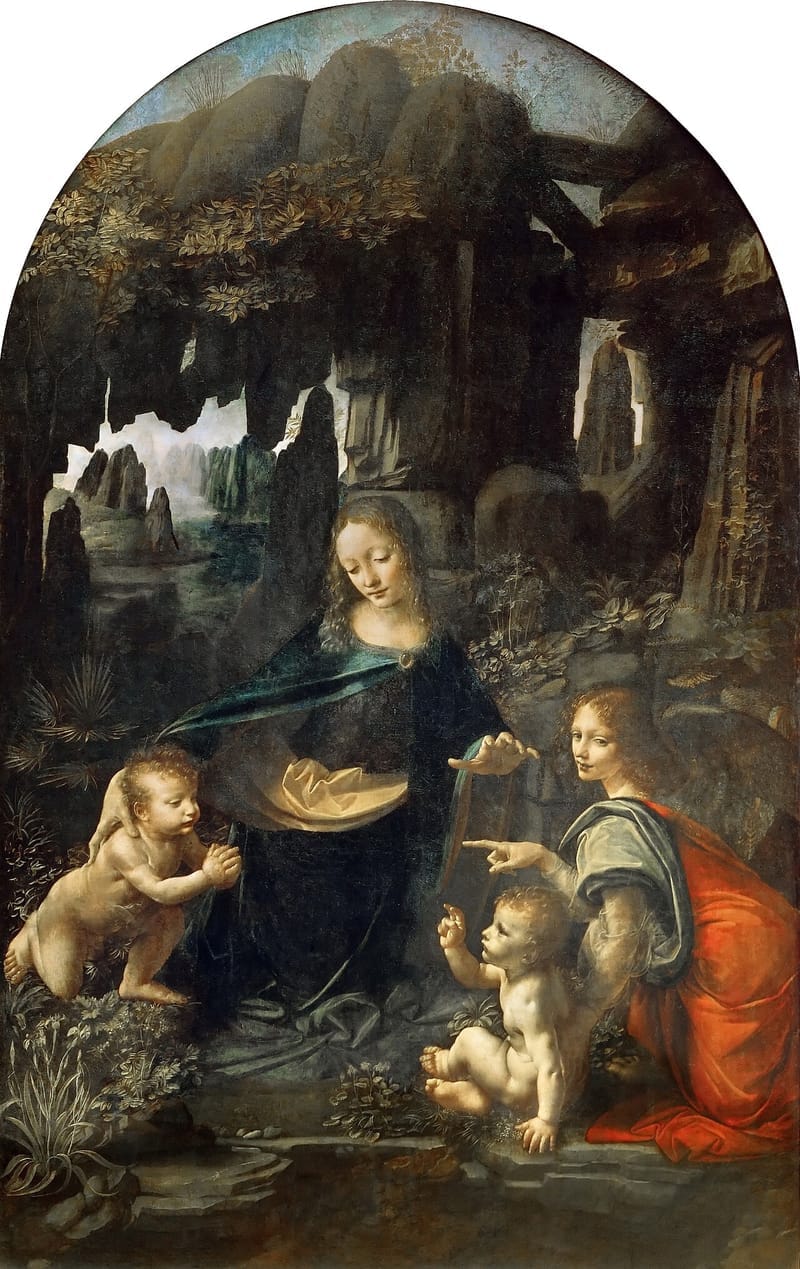
The Virgin of the Rocks, painted in the 1480s. At the center sits the Virgin Mary, with two young children beside her. The figure on the right, dressed in red and pointing toward one of the children, isn't human at all — it's an angel.\n\nSo which of the two children is Jesus? The clue is in the hand gesture. Look closely at the child on the right — his fingers form a blessing that only Jesus is depicted making, and that gesture is directed toward John the Baptist. Curiously, John seems to be the real focal point of this painting: Mary is the one holding him, and the angel points toward him too. According to scripture, John was born six months before Jesus, and here he's painted slightly larger to reflect that. True to the biblical account, John also wears a bit of camel hide draped over him, while Jesus appears with nothing on at all.
These details make for fascinating viewing, but the painting caused real trouble in its day. With John looking like the protagonist, no halos above anyone's head, and the angel's gaze pointed straight out of the frame, the work departed from standard religious painting conventions in several ways at once. The religious confraternity that commissioned it objected strongly, and in the end Leonardo never received proper payment — forcing him to paint a second version, now in London's National Gallery. In that later version, halos were added above the figures' heads, the angel's pointing gesture vanished, its gaze shifted downward, and John was given a staff — his traditional symbol — to remove any doubt about his identity.
Notice how the figures seem to emerge softly from a dark background — this is sfumato, Leonardo's signature technique for blurring outlines so a subject looks as though it's wrapped in mist. He achieved it by painting dark tones first, layering lighter colors on top, and sometimes blending them by smudging with his fingers. Leonardo also arranged his figures within triangular compositions and used aerial perspective — objects growing hazier with distance — to bring Renaissance painting to a new level of technical sophistication.