Paris · Painting
A Painting Shaped by Two Mothers: Da Vinci's The Virgin and Child with Saint Anne
The Virgin and Child with Saint Anne · Paris, France
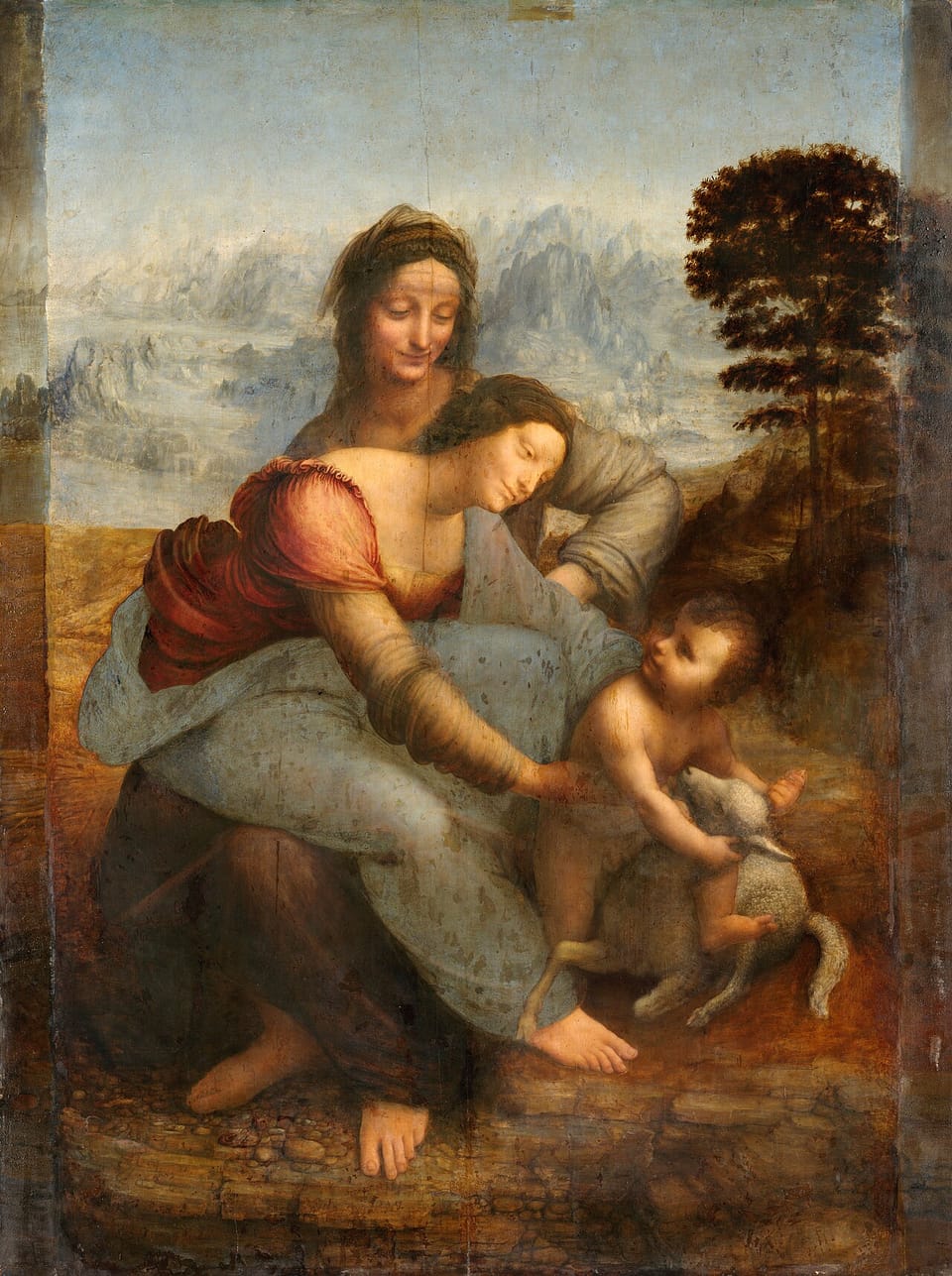
This is Leonardo's The Virgin and Child with Saint Anne. He worked on it for sixteen years but never finished it before his death; the version we see today owes its completed look to a restoration the Louvre carried out over two years starting in 2010.
The infant Jesus is shown holding a small lamb, flanked by two women. The one draped in blue is Mary, his mother, while the woman behind her is Anne, Mary's mother. Curiously, Anne's face looks almost as youthful as her daughter's — even though she's traditionally depicted as an elderly woman, which would actually make sense given that she's meant to be Mary's mother.
So why did Leonardo paint Anne so young? The answer may lie in his own life story. Leonardo was born out of wedlock — his father was already married when he fell in love with Leonardo's mother and had a child with her. Leonardo was raised by his mother until around age five, when he moved into his father's household and was raised from then on by his father's wife, his stepmother. Unlike the wicked stepmothers of fairy tales, she reportedly cared for him with the same devotion a birth mother would show. One interpretation holds that Leonardo carried deep affection for both women — the mother who bore him and the one who raised him — and that this painting reflects exactly that: Mary standing in for the mother who gave birth to him, Saint Anne for the one who raised him, both rendered with the youthful faces he remembered from childhood.
During restoration, infrared reflectography revealed earlier sketches beneath the surface — a horse's head and a differently posed lamb — showing that Leonardo had originally envisioned a different composition before arriving at the one we see today.