Paris · Painting
A Miracle Painted with Friends: Veronese's The Wedding at Cana
The Wedding at Cana · Paris, France
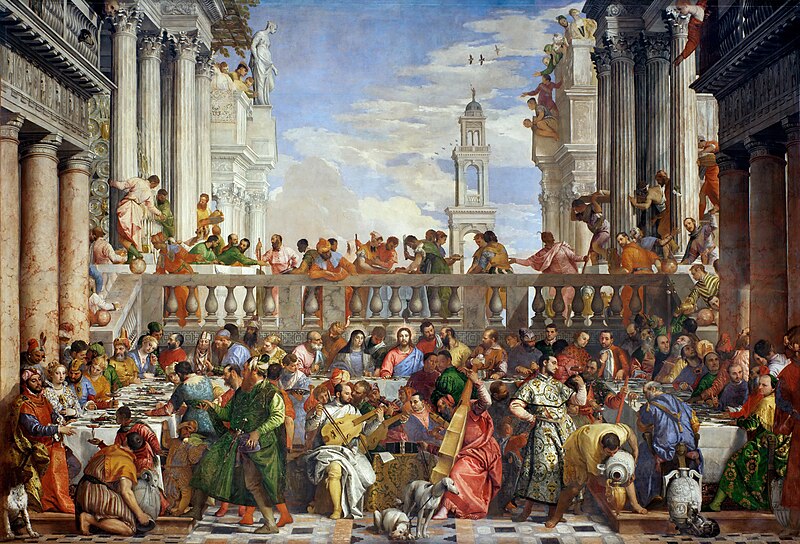
By the late Renaissance, the artistic center of gravity had shifted from Florence and Rome to Venice. The Wedding at Cana, painted by the Venetian artist Veronese, is a defining work of that era, marked by a strong sense of storytelling and expressive, lively figures.\n\nThe largest painting in the Louvre, it originally hung in the Church of San Giorgio Maggiore in Venice before Napoleon seized it during his Italian campaign and brought it to France. The scene depicts Jesus's first recorded miracle: turning water into wine at a wedding in the village of Cana. When the wine ran out, Mary appealed to her son for help; Jesus told the servants to fill jars with water, and when they poured it out, it had become wine. In the lower right, a servant tilts a jar, pouring out deep red wine, while the figures around him react to the astonishing sight.
At the center of the composition sits neither the bride nor groom, but Jesus himself — making clear who the real protagonist of the painting is. Jesus, Mary, and the disciples are dressed in clothing evoking the biblical era, while everyone else in the scene — and the setting itself — reflects the opulence of Venice in Veronese's own time, which is why this humble village wedding looks so lavish.
Veronese also added a scene found nowhere in scripture: a group of musicians, among whom he painted himself and several fellow artists. The man in white is Veronese himself, joined by Bassano, Tintoretto, and Titian, each shown playing an instrument. That painters could insert their own likenesses into a religious scene reflects how Venice, more than other cities of the time, gave artists relative freedom from religious constraints.
The actual bride and groom sit quietly in the far left corner — dressed in the most elaborate clothing in the painting, yet wearing the gloomiest expressions of anyone present, worried that their wine has run dry. Interestingly, the bearded man shown leaning in toward the bride is believed to represent King Francis I of France — the monarch who waged war on Italy and brought Leonardo da Vinci to France. Some read this as Veronese, an Italian painter, taking a quiet jab at him.
The painting also hides several symbols foreshadowing Jesus's death: a black jug tilted slightly above his head, alluding to the blood he will shed; figures carving meat just below, evoking his role as the sacrificial "Lamb of God"; and an hourglass resting on a table among the musicians, a quiet reminder that his time is running short.
Of the many works Napoleon looted from Italy, a good number were eventually returned after negotiations led by the sculptor Antonio Canova. This painting, however, stayed in Paris — Vivant Denon, the Louvre's first director, reportedly hid it away so it couldn't be reclaimed, which is why it remains here to this day.
Included in the Paris tour.
Open the free appFree iPhone app