Paris · Painting
The Moment a Dead Beauty Stirs Again: Cimabue
Virgin and Child Surrounded by Six Angels · Paris, France
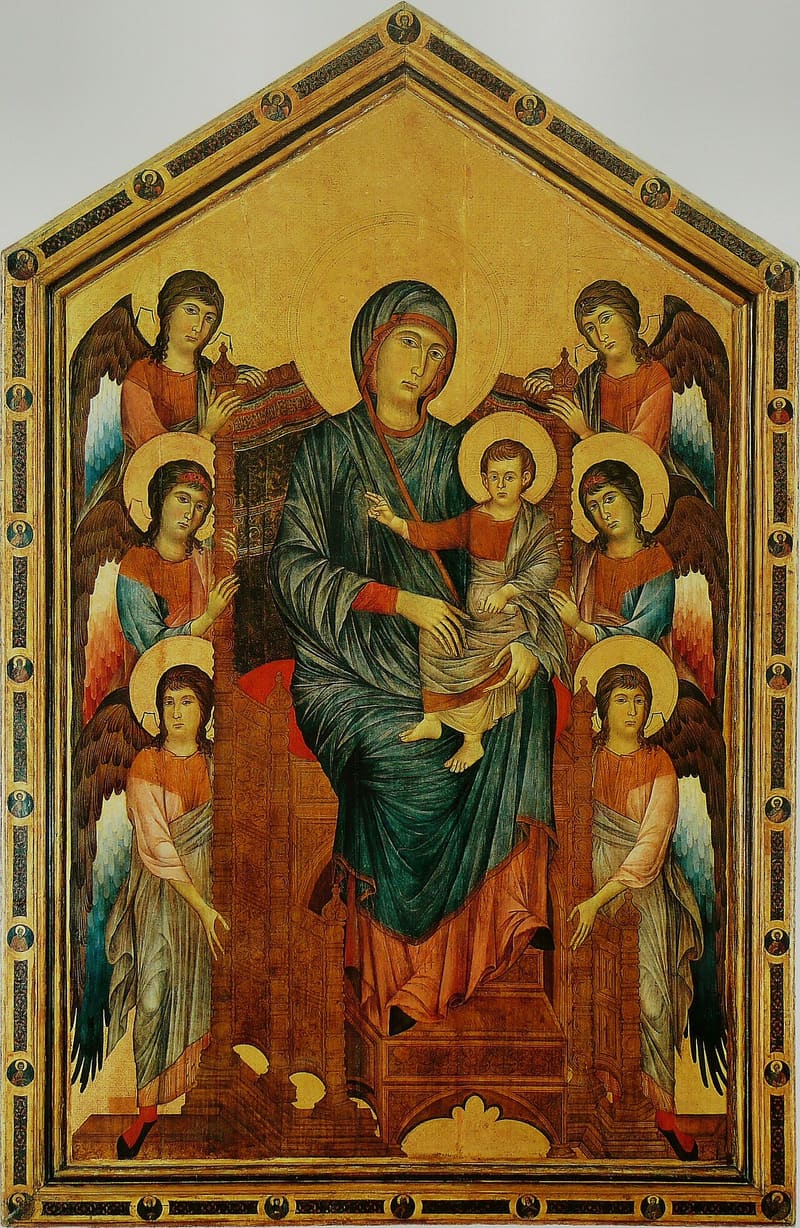
This room brings together the works of trailblazers ahead of their time — the pioneers of the Renaissance. The first painting we encounter is Madonna and Child Enthroned with Six Angels, by Cimabue, a painter of the Florentine school. "Madonna and Child" refers to Jesus and his mother, Mary.\n\nPainted on wood panel with gleaming gold leaf, this work at first glance seems to carry over every hallmark of medieval Byzantine religious painting. So why does it hang not in the medieval galleries, but at the very opening of the Renaissance rooms?\n\nThere's still no trace of tenderness in the mother's gaze toward her son — that leap hadn't happened yet. But elsewhere in the painting, a classical beauty long thought dead is quietly stirring back to life: in the drapery. The way the fabric folds and cascades down is more advanced than anything else being painted at the time.\n\nNotice, too, the throne — it's set at a slight angle. Typical Byzantine paintings were flat, reflecting a worldview centered entirely on God, with almost no sense of depth. But as the person looking at the world shifted from God to the human artist himself, a new sense of space began creeping into painting — things nearby appearing larger, things farther away appearing smaller. The tilted throne is an early attempt at creating exactly that illusion of depth.\n\nFinally, take note of Jesus's right hand, with two fingers raised — a gesture symbolizing Christ's blessing that will resurface again in later works on this tour.