Paris · Sculpture
Venus de Milo: More Striking Without Her Arms
Venus de Milo · Paris, France
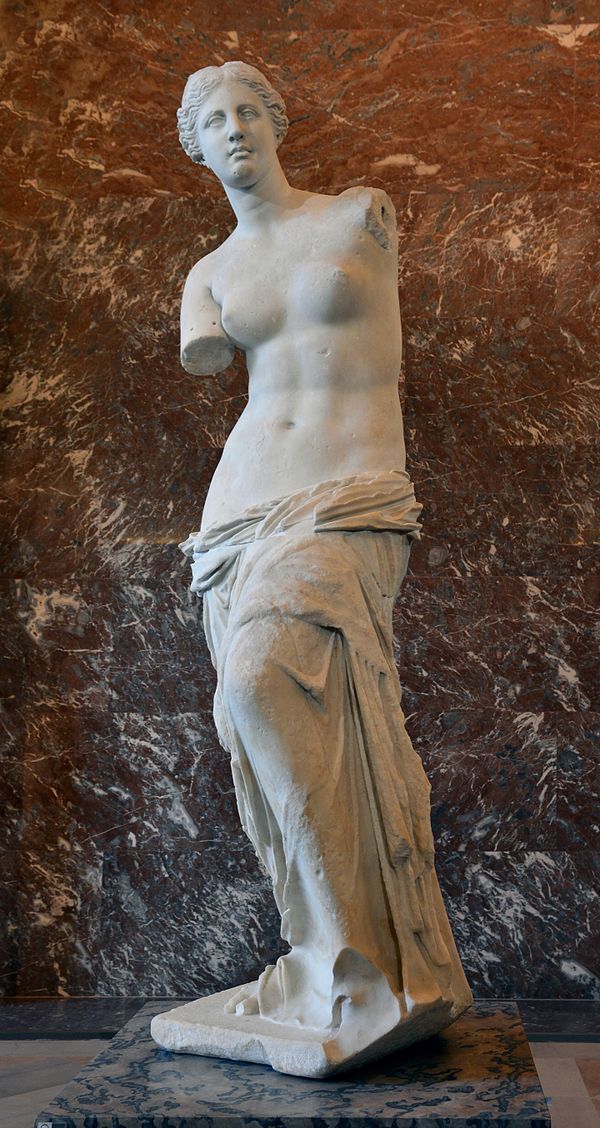
The statue you're looking at is the Venus de Milo. As stunning as it is, no one knows who made it — its name comes not from an artist, but from the place where it was found.
A farmer on the Greek island of Milos stumbled on the statue by accident in the 1820s while working his field. It was found split into upper and lower halves, with the arms still attached. Even at first glance it was clearly something special, and the farmer showed it to a French diplomat nearby, who bought it on the spot. A year later it was presented to King Louis XVIII, and it has stood in the Louvre ever since.
When the statue first arrived in France, it caused a sensation among art lovers, for three reasons. First, it finally gave the Louvre a sculpture worthy of representing Greco-Roman civilization. Its predecessor in that role, the Laocoön Group, had just been returned to Italy after Napoleon's fall, leaving a gap the French were eager to fill. Second was the golden ratio: the proportions between the statue's upper and lower body were believed to follow the golden ratio of 1:1.618, which only heightened public excitement. Third — and perhaps most memorably — was the fact that it had no arms. The statue is thought to have originally had arms intact, likely broken off in transit to France. The Louvre once considered restoring them, but leaving the figure armless ended up drawing more attention to the striking curve of her body, and left everyone free to imagine what those missing arms might have looked like.
Based on the break near the right shoulder and a slight twist at the hip, experts believe the right arm once reached down to hold a slipping fold of drapery. And given how the left shoulder is raised, some think the left hand may have held a golden apple, one of Venus's traditional symbols.
Included in the Paris tour.
Open the free appFree iPhone app