Paris · Painting
The Saint Who Survived a Body Full of Arrows: Mantegna's Saint Sebastian
Saint Sebastian · Paris, France
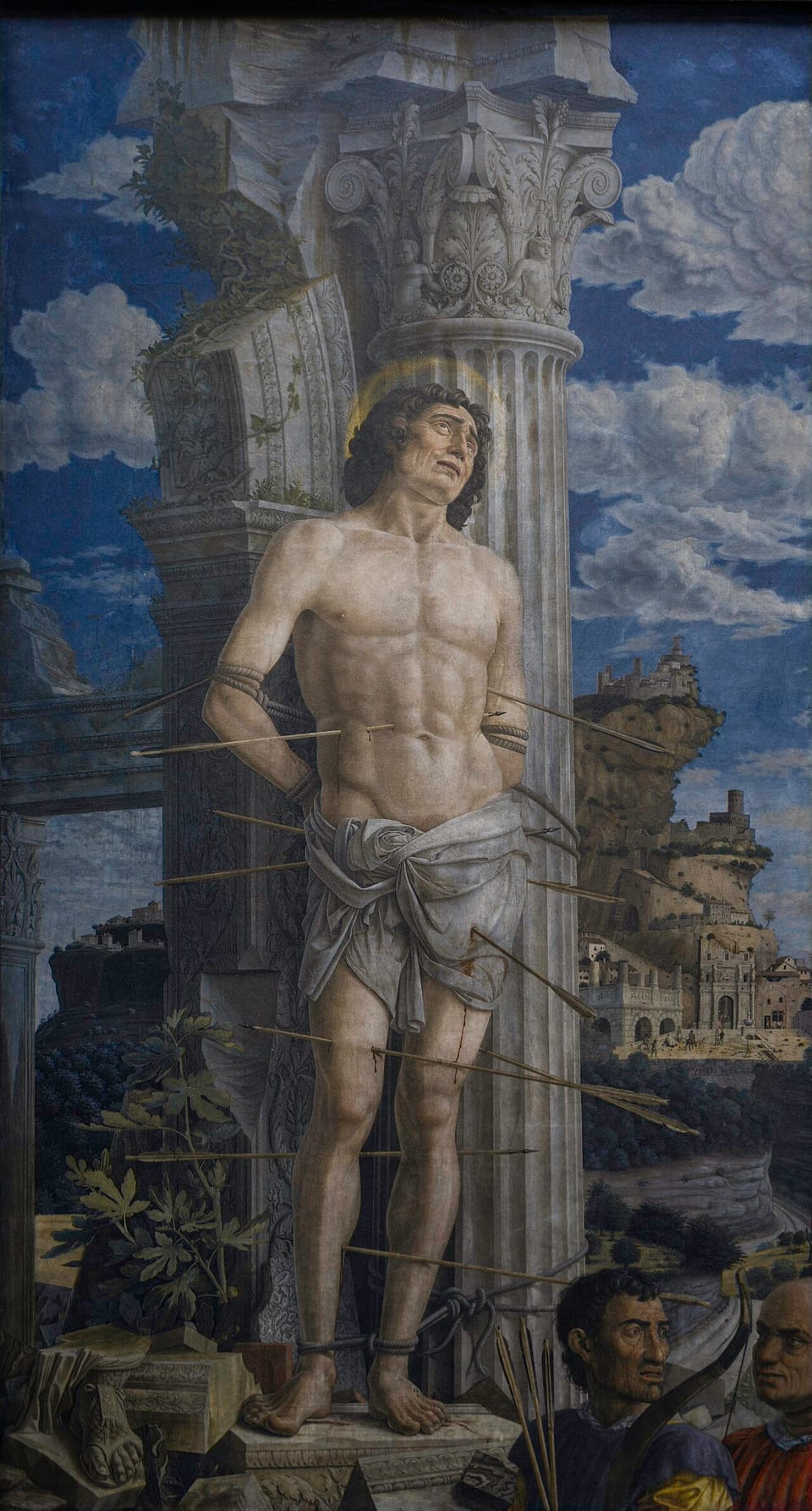
This is Andrea Mantegna's Martyrdom of Saint Sebastian. Bound to a column and pierced with arrows from head to toe, this man is Saint Sebastian.\n\nSebastian served as a captain of the guard under the Roman emperor Diocletian, but was sentenced to death by arrows once his Christianity was discovered. Strangely enough, though, the soldiers' arrows all missed his vital organs — his heart, his throat — striking mostly his legs instead, and he survived. This painting captures that very moment of the miracle.\n\nHaving barely escaped death, Sebastian went back before the emperor and showed him his wounds, saying, "The fact that I survived this is itself proof that God exists." Furious at these words, Diocletian ordered his soldiers to beat Sebastian to death with clubs instead — and this time, Sebastian did not survive.\n\nTravel around Europe and you'll run into Saint Sebastian again and again, in paintings and sculpture alike, for two reasons. First, he's the patron saint of plague victims. Medieval Europeans saw the plague as a kind of divine arrow-punishment, raining down inescapably from above — and since Sebastian was the man who'd survived exactly that fate, he became the natural protector against it. Once the plague eventually subsided, people credited his protection, and his image spread even further across Europe as a result.\n\nSecond, his story gave artists a rare license to paint the male body. Most saints in religious art of the time were shown fully clothed — only figures like Adam and Eve, or Christ on the cross, appeared unclothed. As a soldier, Sebastian made a fitting subject for depicting a strong, athletic physique, which is exactly why his martyrdom became such a popular theme in Renaissance painting, with Mantegna's version, seen here, standing as one of its finest examples.