Paris · Painting
Obsessed with the Vanishing Point: Uccello's Battle of San Romano
The Battle of San Romano · Paris, France
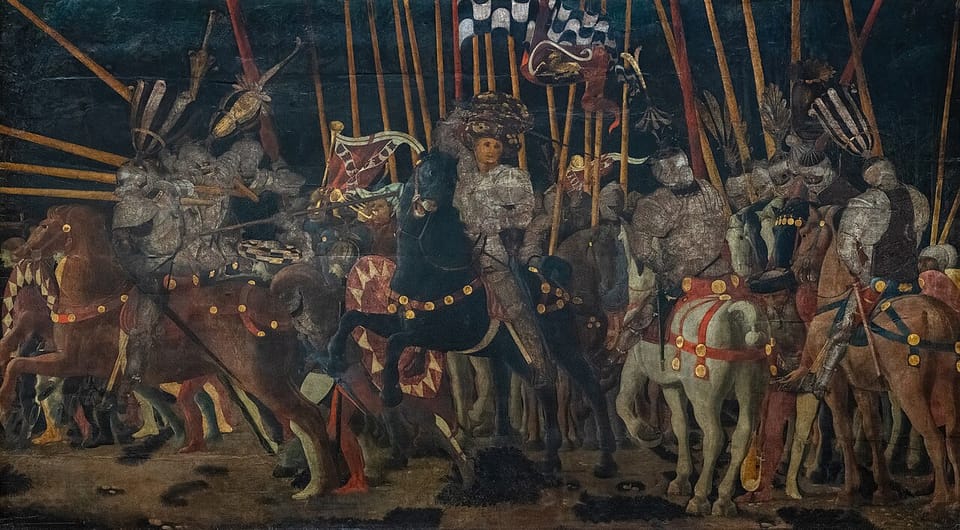
This is Paolo Uccello's Battle of San Romano, depicting an outnumbered Florence's 1432 victory over Siena, two rival city-states. It was commissioned by Leonardo Bartolini, a Florentine banker, who wanted it hung in his own bedroom.
The painting is rectangular today, but it wasn't originally — it once had a rounded arch at the top. Bartolini's bedroom wall had three arched niches, so Uccello painted three scenes to match: a morning battle, a midday battle, and an evening battle. After Bartolini died, his sons inherited the paintings — until the Medici family took notice, demanded to buy them, were refused, and simply stole them in the night. Since the Medici's own display space wasn't arched, they sawed off the tops to make the rectangles we see today, which is why the spears and banners along the upper edge look oddly cropped. Bartolini's sons sued to get the paintings back, but the Medici were too powerful in Florence at the time, and the family never recovered them.
When the Medici dynasty eventually collapsed, the three panels were split up and scattered. The morning battle now hangs in London's National Gallery, the midday battle in the Uffizi in Florence, and the evening battle — the one on display here — is the piece we're looking at now. The rider at the center represents Florentine reinforcements, whose counterattack secures Florence's victory over Siena.
What makes this painting remarkable isn't so much its subject as its technique. Uccello built the whole composition around a single vanishing point, with everything converging on it in careful order — even the yellow lances above aren't scattered at random but line up precisely toward that point. He also used foreshortening, painting the horse on the left elongated while the ones on the right appear compressed, creating a sense of depth between them. The result has a few awkward passages, but that relentless focus on perspective is exactly why Uccello is remembered as a pioneer of Renaissance perspective.