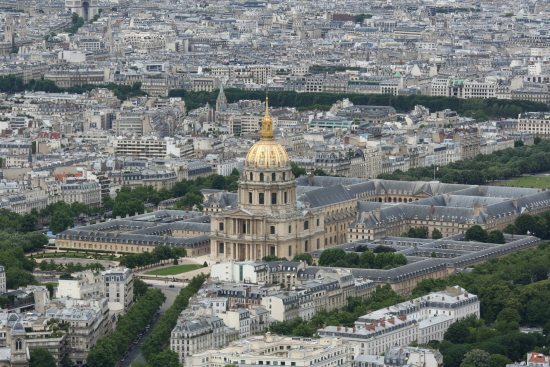
Paris · Palace & Rooms
Napoleon's Resting Place: The Dôme Church
Les Invalides · Paris, France
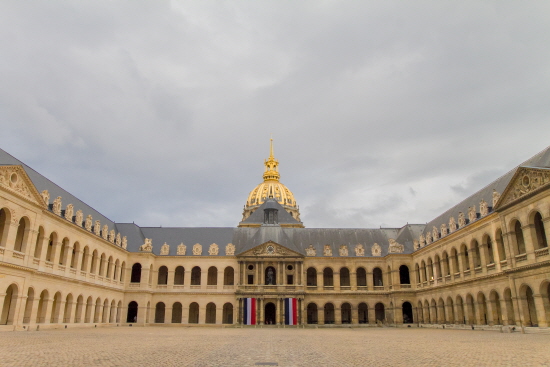
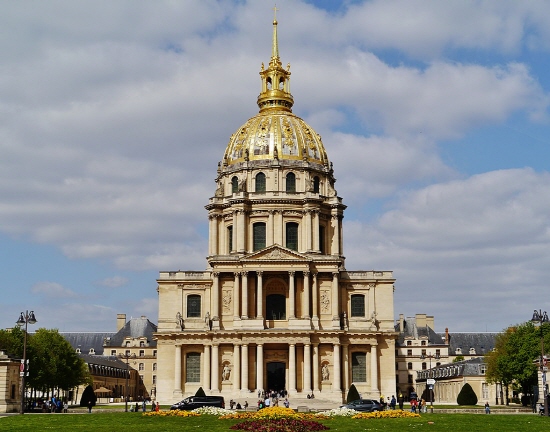
Step through the entrance and you'll find a broad, square, plaza-like space called the Cour d'Honneur ("Court of Honor"). Like the entrance, it is lined with cannons from the 17th to 19th centuries. Opposite stands the Church of Saint-Louis des Invalides, along with the Dôme Church, built as a royal chapel and home to the tomb of Napoleon I. Les Invalides is a sprawling complex that can feel confusing, so keep a map handy. Before the Army Museum, let's visit the Dôme Church, where Napoleon I lies.
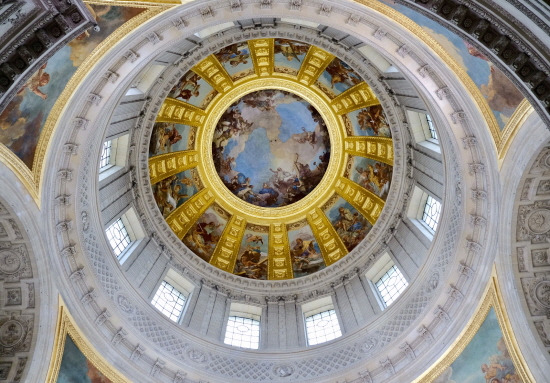
The Dôme Church is one of France's great Baroque buildings, and it shows touches of French classicism too. It is lavish, grand and deliberately exaggerated. Baroque was a style that emerged after the Renaissance, across 17th- and 18th-century Europe, in architecture, painting, sculpture and more. The German art historian Winckelmann, who held ancient Greek art to be the greatest of all, is said to have taken the word "baroque" from a Portuguese term meaning "misshapen pearl." Baroque art distorted and exaggerated form for dramatic effect, aiming for a powerful impression. Both the exterior and the interior of the church are richly decorated, with frescoes among the ornament. The painting on the dome's ceiling shows Saint Louis in glory among angels, and it was made between 1702 and 1706.
Walk toward the altar and you can look up into the underside of the golden dome. Below it, in the crypt, lies Napoleon's tomb. Everyone has heard the name Napoleon Bonaparte. He is generally regarded as a great French leader and hero: a soldier who won fame through a string of victorious campaigns and became First Consul after the Revolution. After taking power he shifted to an imperial system and carried out reforms. But his Russian campaign of 1812 failed and he was exiled to Elba; after escaping, he was defeated again at Waterloo in 1815 and exiled to Saint Helena in the Atlantic, where he died. His dazzling political fame and his sad end make a striking contrast.
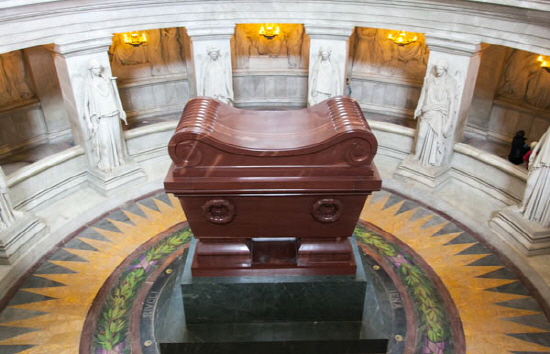
The sarcophagus is designed so you can look down on it from the main floor without going below, though you can also take the stairs down to the crypt. The church was remodeled in 1842 and 1853 to make room for Napoleon's tomb. The sarcophagus, made of red stone, is very large and rests on a base of green granite.
Napoleon is not alone here. Other war heroes and French generals who achieved great military feats are also laid to rest. Just as the Panthéon in Paris honors great figures of France, Les Invalides honors its distinguished soldiers.