Paris · Painting
Poppy Field at Argenteuil
Giverny · Paris, France
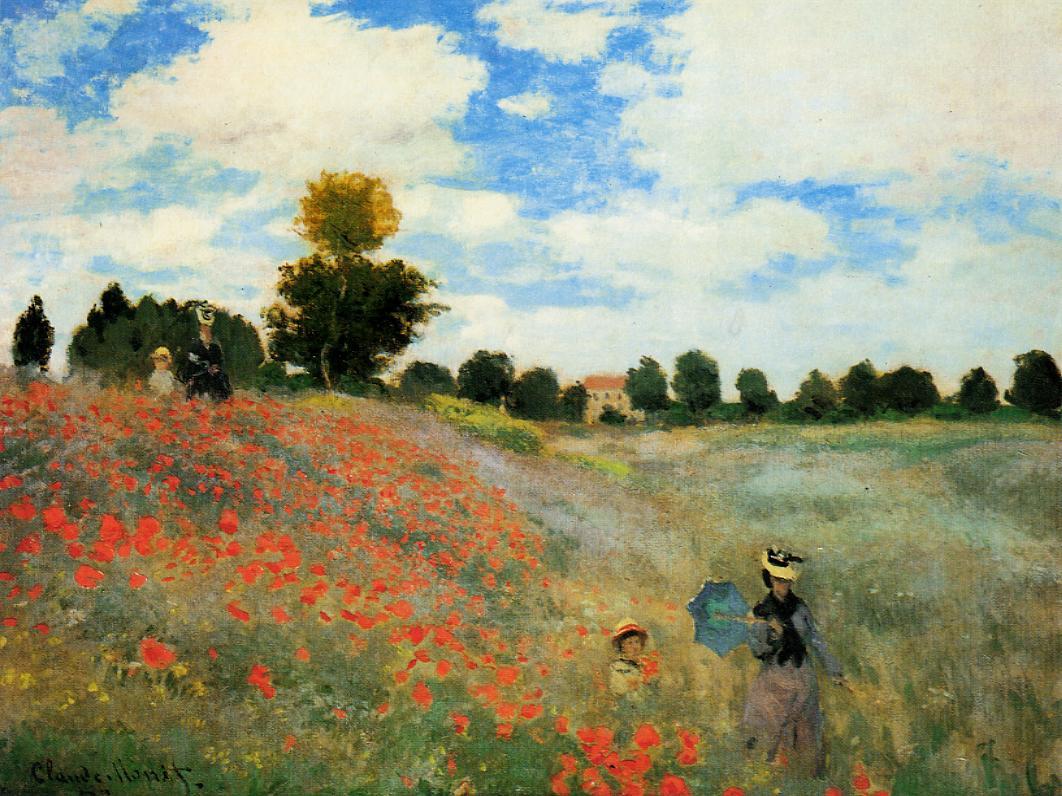
This painting isn't on display in this room, but it's one of Monet's best-known works and you can see it in the gift shop, so let's start with it. "Poppy Field at Argenteuil" shows his wife Camille and their first son, Jean. Look closely and you'll spot two more figures, faint, at the back left. The two in front and the two behind are the same pair, Camille and Jean.
The painting is often cited as a prime example of Impressionism. Impressionists don't paint things realistically. If this were realistic, it would be a rather eerie picture, with the same people appearing twice. Impressionism paints what is seen: the impression that shifts from moment to moment depending on what light the painter catches at a given instant. Monet worked fast, but it was oil paint, and he couldn't finish in a few minutes. After standing as a model for so long, little Jean got restless and finally couldn't help wandering up the hill. When Camille climbed up to fetch him, Monet found the sight beautiful. "Stay right there for a second," he called, and with quick brushstrokes painted the two of them once more. That is how "Poppy Field at Argenteuil" came to be, a painting as sweet as its story.
While Monet, Camille and Jean were living happily, their household suddenly grew by seven. It wasn't septuplets: Alice Hoschedé, the wife of Monet's patron Hoschedé, and her six children moved in. Hoschedé was a wealthy man who ran a department store and owned a country house, and he had supported Monet through his money troubles. He had commissioned paintings from Monet to decorate his house. Then one day he went bankrupt. Unable to bear the debts or the news of his bankruptcy spreading across Paris, Hoschedé ran away alone, leaving his wife and six children. With nowhere to go, Alice turned to Monet, whom she had supported. Monet had been a beneficiary himself and felt for her plight, so he took them in.
The year after the household grew by seven, Camille gave birth to their second son, Michel. Monet, Camille, Jean and Michel, together with Alice Hoschedé and her six children, made eleven. But ten people moved to Giverny. One was missing: Camille, shown in this painting, grew weak after Michel's birth and died at the young age of thirty-two. There is a painting of her last moments in this house. See the next chapter.