Paris · Painting
The Town Hall on Bastille Day, and Van Gogh's Statue
Auvers-sur-Oise · Paris, France
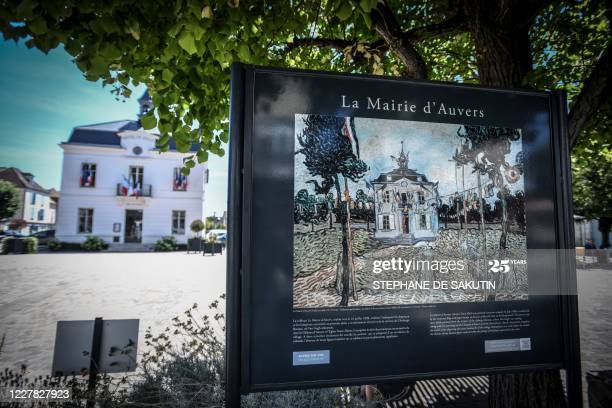
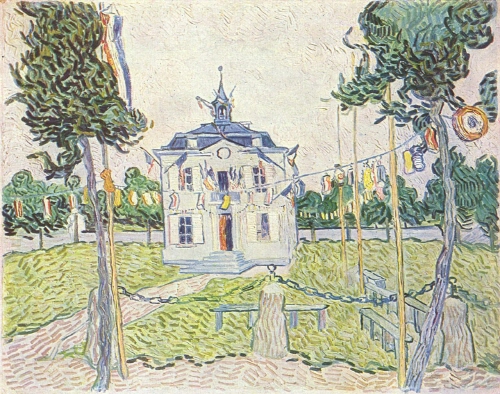
Standing in front of the town hall, many people recall Van Gogh's painting and remark, "He just painted the town hall. Nothing has changed since then." But the date in the painting is no ordinary one. It is 14 July, Bastille Day, France's biggest public holiday, when the country puts on a grand fireworks display once a year. You can tell how important the day is to the French.
Auvers' town hall stands just across the street from the Ravoux Inn. It is well over 120 years old, but so well kept that it looks almost identical to the building in the painting, neat and pretty. As in the painting, the tricolour flag, a symbol of liberty, equality and fraternity, flutters over the building. Van Gogh painted many more flags than that, all decorations for Bastille Day. While the townspeople probably enjoyed the festivities on 14 July, Van Gogh seems not to have shared their mood. Perhaps he painted alone and forlorn, gazing at the town hall after everyone had finished celebrating and gone home.
He painted the town hall on a relatively large canvas in mid-July 1890, when the trees and grass were green. The work is unfinished, yet his trademark rapid brushwork makes it a masterpiece painted with abandon. The winding, distinctive strokes and the dancing trees are something only Van Gogh could achieve. Foreground and background share the same colour saturation, yet it conveys depth because he expressed distance through size. His technique disregarded perspective and the shapes of his subjects, distorting form and colour according to his feelings, which, as mentioned earlier, influenced Expressionism. Auvers' town hall, an ordinary little government office in the countryside, caught a great painter's eye and became a work of art, and tourists now flock here from around the world. Van Gogh turned not just this building but Auvers' humble church, gardens, wheat fields and lanes into world-famous sights overnight.
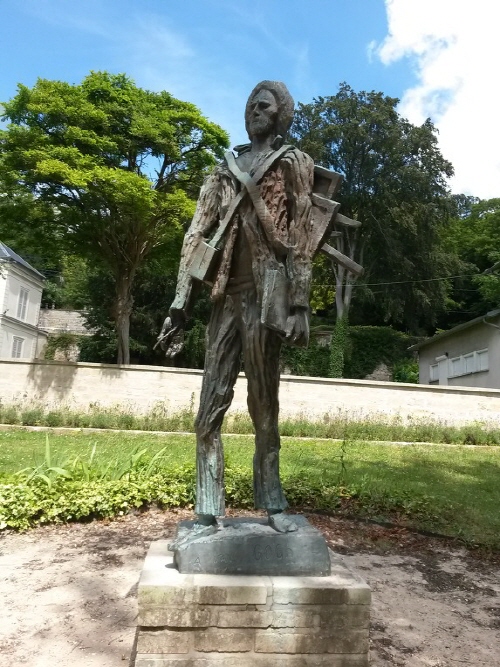
With your back to the town hall, walk a little way to the right and you will reach a small park. A statue of Van Gogh stands in the middle, with a tourist information office behind it. The statue shows him painfully thin. Whether it's true or not, he is said to have had barely ten proper meals in his 70 days in Auvers, living on baguettes and drink. Perhaps he was naturally slim, but the statue is so gaunt it looks pitiful. Hunched under the weight of his easel and paint box, he seems to carry a burden like that of his own life. Standing before it, you can't help thinking again of a man who struggled in poverty all his life and, at times beset by cruelty and prejudice for being different, died unrecognised. Van Gogh was fairly tall, but his slightly stooped posture hints at an inner life that never stood proudly before the world, while his gaze, fixed on something in the distance, recalls the nature he saw and the impressions he felt. Be sure to hold the statue's hand and take a photo.