The Hall of Mirrors
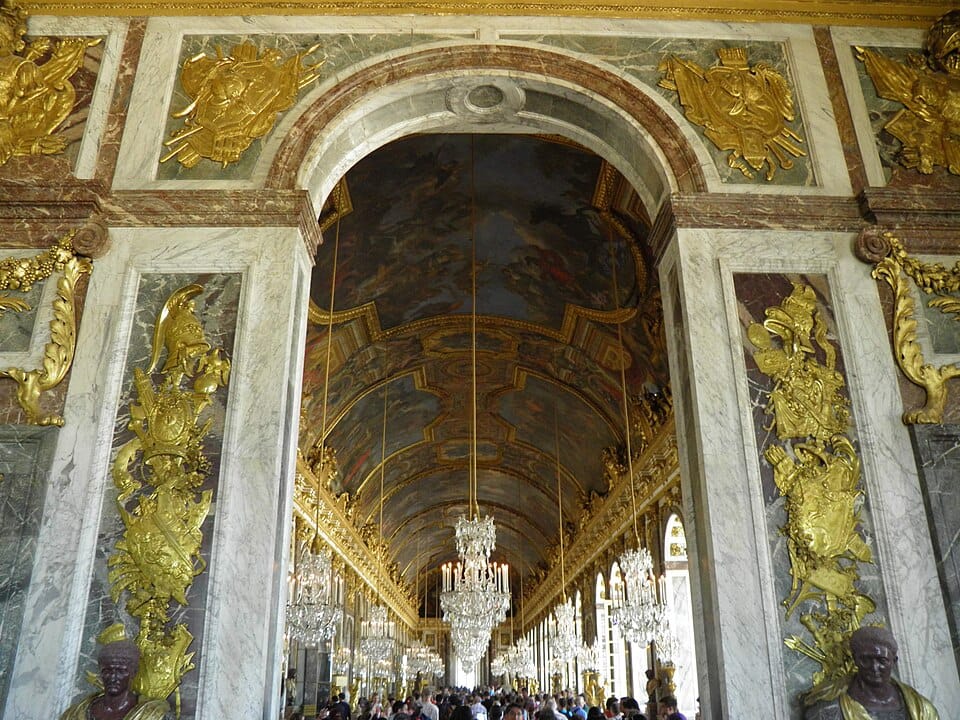
Have you made it into the Hall of Mirrors?
Along the wall to your left, you'll see a long row of mirrors.
On your right are windows that mirror their shape.
Sunlight streams through the windows and reflects off the mirrors, filling the room with a brilliant glow.
It's impossible to resist taking a photo in a place this beautiful.
It would be wonderful to have the room all to yourself for a full-body photo, but with so many visitors, that's not very realistic.
So let me share three quick photography tips.
First, hold your phone slightly below face level and angle it upward.
That way, you'll capture fewer people in the background while fitting both the magnificent ceiling and the mirrors into your shot.
Second, don't stop to take photos right at the entrance to the Hall of Mirrors.
That's where almost everyone takes their first picture.
Instead, keep following the tour, and when you spot a quieter section, quickly take your photo there.
And finally, you can always use an AI photo-editing tool to remove any people who accidentally end up in the background.
I'll continue telling you the story of this room, so take your photos whenever you find the perfect moment.
There are seventeen arched mirrors in this hall.
Why do you think there are exactly seventeen?
That's because construction of the Hall of Mirrors began in 1678, exactly seventeen years after Louis XIV began his personal rule.
Each arch contains twenty-one mirrors, making a total of three hundred fifty-seven. It's estimated that each individual mirror was worth roughly the equivalent of five kilograms of gold.
Quite astonishing, isn't it?
At the time, Venice held a monopoly on the art of mirror-making.
In today's terms, it was the equivalent of cutting-edge semiconductor technology.
So France launched an industrial espionage operation, paying Venetian master craftsmen enormous sums to defect.
There was a clear reason why France went to such extraordinary lengths to build the Hall of Mirrors.
It was to prove that France could produce mirrors of this quality without relying on Italy, and in doing so, demonstrate the nation's superiority.
Now, let's look up at the ceiling.
There are thirty paintings in total.
Do you remember the sketches by Charles Le Brun that we saw downstairs?
Here you can finally see the completed masterpieces.
Let's take a look at the central ceiling painting, The King Governs by Himself.
This ceiling painting is more than just a work of art—it's Louis XIV's autobiography in paint.
In the rooms we've visited so far, the ceilings celebrated him through the imagery of the gods. But here, Louis XIV appears as himself.
In other words, the figure in the painting is Louis XIV himself.
Rather than standing in for him, the figures from mythology have been pushed to the edges, surrounding Louis XIV instead.
It's a visual declaration that, as God's representative on earth, Louis XIV exercised absolute authority.
In his hand, he firmly grips a ship's rudder, symbolizing his determination to steer the destiny of France with his own hands.
This hall was primarily used for grand banquets and masquerade balls.
It also served as the setting for official ceremonies, including receptions for foreign monarchs and ambassadors.
Even today, it continues to host important national and international events.
Perhaps the most famous event ever held here was the signing of the Treaty of Versailles.
In the photographs taken that day, the Hall of Mirrors is unmistakable in the background.
The Treaty of Versailles was the peace treaty signed in 1919 between the Allied Powers and Germany after the end of the First World War.
I'm sure you've heard of it.
But have you heard this part of the story?
The fact that it was signed right here was a dramatic act of revenge.
Nearly fifty years before the Treaty of Versailles was signed, France suffered a humiliating defeat at the hands of Germany.
After defeating France in the Franco-Prussian War, King Wilhelm I of Prussia occupied this very Hall of Mirrors.
It was here that he proclaimed the birth of the German Empire and became the first German Emperor.
The Hall of Mirrors probably looks familiar, doesn't it?
Half a century later, France finally avenged that humiliation in the very same room.
Almost as if the mirrors themselves had reflected that humiliation back onto Germany.
Now, if you've finished taking your photos, let's move on to the next room.