The Apollo Room
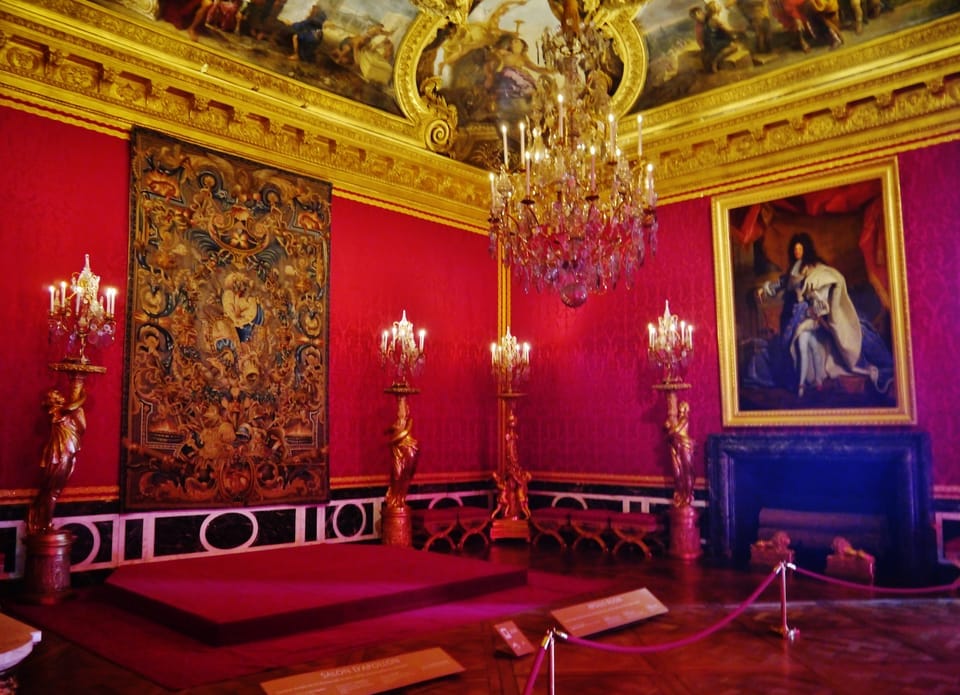
On the ceiling, you'll see Apollo riding a chariot drawn by four horses, with the rays of the sun shining behind him.
Apollo was the god of the sun, and the deity Louis XIV chose to identify himself with.
Just as the sun is the center of the solar system, Louis XIV saw himself as the center of France.
On the empty platform in the center of the room once stood the king's silver-covered throne, which stood 2.6 meters tall.
Seated on that throne, Louis XIV held councils of state with his ministers.
Now, let's take a look at the portrait of Louis XIV near the exit.
Historians estimate that more than seven hundred portraits of Louis XIV were painted during his lifetime, and this is undoubtedly the most famous of them all.
Even today, it continues to appear everywhere.
In fact, you've probably already seen it somewhere since arriving in France.
The painting you're looking at, however, is a copy. The original is in the Louvre Museum.
Louis XIV originally commissioned the portrait as a gift for his grandson, Philip V of Spain. But he loved the finished painting so much that he kept the original for himself and commissioned the same artist to paint the copy you're looking at now.
Even though this is only a copy, it carried authority almost equal to that of the king himself.
Do you remember what I mentioned in the Room of Abundance?
Just as visitors were expected to bow to the king's ceremonial vessel, they were expected to show the same respect to this portrait.
Turning your back on it was considered unacceptable.
Louis XIV is sixty-three years old in this portrait.
Even in his sixties, his appearance is remarkably extravagant.
What caught my attention most were his wig, his stockings, and his high heels.
Let's start with the wig.
He contracted smallpox in his teens and measles in his twenties, and the aftereffects caused him to lose much of his hair.
From then on, he became obsessed with wigs.
Louis XIV was also relatively short, standing at about 163 centimeters, even by the standards of his time. He reportedly used the height of his wig to make himself appear taller.
That's also why he wore high heels.
Just as he sought to project an image of greater authority, he also wore shoes with heels over ten centimeters high to make himself appear taller.
Notice the bright red heels.
Red dye was extremely expensive at the time, so the color instantly signaled wealth and power, even from a distance.
They also helped accentuate the shape of his legs.
And to show them off even more, he wore stockings.
Well-shaped legs were considered an important standard of male beauty among the nobility.
Having trained in classical ballet from childhood, Louis XIV had strong, well-developed legs, and he highlighted them with close-fitting silk stockings to project an image of strength and elegance.
Ironically, by the time this portrait was painted in 1701, he was using a wheelchair because his gout had become much worse.
Yet the artist still portrayed him with strong, powerful legs to reinforce the image of an invincible king.
Now that you've heard the story behind the portrait, don't those magnificent royal accessories seem less like symbols of power and more like a way of concealing the frailty of an ordinary man?
With that, we've explored all seven rooms of the King's Grand Apartment.
Even grander and more magnificent rooms await us next.
I think you're going to love them.
Please move into the next room and start the next chapter.