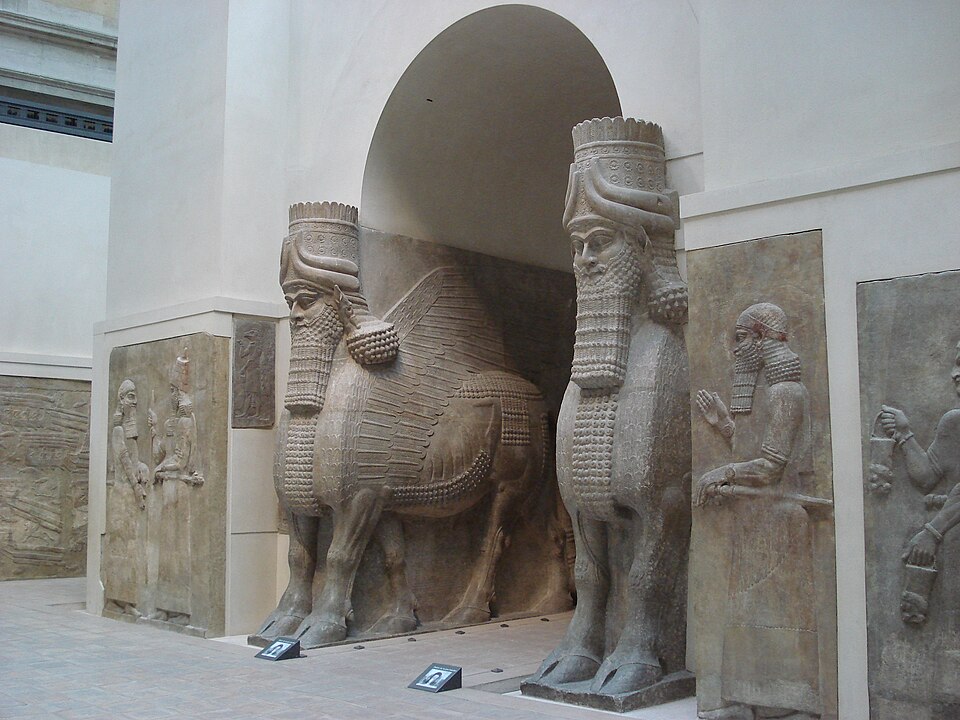
Lamassu of Khorsabad
Transcript
Here's what your guide tells you about this work in the MuseCat app.
We skip forward a thousand years. After Hammurabi, power in Mesopotamia passed to a new empire: Assyria. The Assyrian king Sargon II decided to build a city called Khorsabad. Back then, cities grew on their own: people gathered together and villages became cities. But Khorsabad was different: planned from the start. It's one of the first examples of a planned city in history.
But this enormous city vanished. A great flood buried it under six meters of sediment. And it stayed underground for centuries. In 1844, a French doctor named Émile Botta excavated the area near Mosul, in present-day Iraq, together with local residents. And he found Khorsabad. Everything you see here was brought exactly as found. It's all original. Just from the size of these sculptures, you can get a sense of how powerful the Assyrian Empire was.
Let's look at them one by one. Those enormous figures against the wall are the Lamassu, the guardians of the royal palace. Look at the head. Crown, long beard, long hair. Back then, not just anyone could wear a long beard or long hair. It was a privilege reserved for the king. Crown, long beard, long hair: all symbols of royalty.
Now look at the frieze next to it, the reliefs with courtiers in procession. See they have no beard? And the ones behind them have beards, but short ones. The length of the beard marked your social status.
Let's go back to the Lamassu. The body is a bull. In this region, the bull was the ultimate symbol of power. The muscles, the veins: all of that represents the strength and energy of the Assyrian Empire. And the wings are those of an eagle. The wings symbolize the empire. Between the legs there are cuneiform inscriptions listing the achievements of Sargon II: how he built this city, what he did for his people.
And now look at the legs. From the front, the Lamassu is standing still. From the side, it's walking. Count the legs from the side. There aren't four. There are five. It's not a mistake. It's a solution: it works from both perspectives at the same time. Isn't that incredible?
And right next to it there's another figure I love. A man holding a lion like it's a kitten. That's Gilgamesh. The hero of the Epic of Gilgamesh, the first epic work in human history. And as you can see, he's shown holding a lion with total ease. Look at the detail of the lion: the teeth, the claws, the bracelet, the earrings. All carved with astonishing precision.
And here's something interesting. Mesopotamia and Egypt were geographically close. But their way of understanding art was completely opposite. Mesopotamia represented the world as you see it: natural, real, from a human perspective. Egypt sought the essence of things, the eternal, what doesn't change. That's why Egyptian art seems so rigid. Two neighboring civilizations, two radically different visions of the world.
One last thing. Does the name Syria sound familiar to you? The name comes directly from Assyria. And it's not a coincidence: at its peak, the Assyrian Empire included what is today Syria, Israel, Iraq, and part of Turkey.