Paris · Palace & Rooms
The Hall of Mirrors
Palace of Versailles · Paris, France
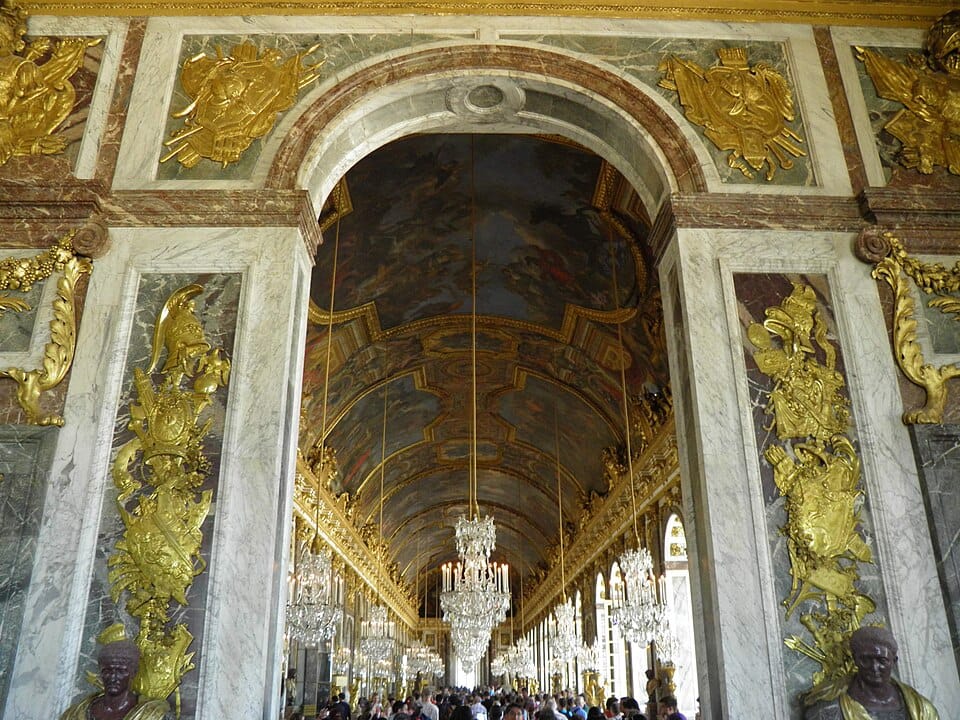
The Hall of Mirrors is lined on one side with a row of mirrors and, facing them, a row of mirror-shaped windows. Sunlight pouring through the windows reflects off the mirrors, filling the entire gallery with light.
The room holds seventeen arched mirrors in total. Construction began in 1678, the seventeenth year of Louis XIV's personal rule, and the number is said to echo that milestone. Each arch contains twenty-one panes, 357 mirrors in all, with each pane estimated to have been worth roughly five kilograms of gold. At the time, Venice held a monopoly on mirror-making technology, so France spent lavishly to secretly lure Venetian craftsmen away and establish its own production. The goal was to prove that France could produce mirrors of this caliber without Italian help, a demonstration of French technical skill and ambition.
The ceiling holds thirty paintings in all. Among these works by Charles Le Brun, the central painting, The King Governs Alone, is less a decorative piece than a visual autobiography of Louis XIV. Where other rooms portrayed the king through the guise of gods, here Louis XIV appears in person, while mythological figures are pushed to the margins around him. The composition visually declares that Louis XIV wielded absolute power on earth as the gods' representative, and the ship's rudder in his hand symbolizes his determination to steer his own destiny. The hall was used for grand receptions, masked balls, and official audiences with foreign monarchs and envoys, and it continues to host events today.
The most significant event held here was the Treaty of Versailles, signed in 1919 to end the First World War between the Allied powers and defeated Germany. The treaty carries a striking historical irony: roughly fifty years earlier, after Prussia's victory over France in the Franco-Prussian War, Kaiser Wilhelm I had occupied this very hall and proclaimed the founding of the German Empire here, crowning himself emperor. Signed in the same room half a century later, the Treaty of Versailles is seen as France's symbolic repayment of that humiliation.
The space also has ties to more recent history: in 2002, Samsung Electronics rented the entire Palace of Versailles to host a global roadshow unveiling its cutting-edge products.