Paris · City Walks
The Louvre at Night: From the Cour Carrée to the Glass Pyramid
Paris · Paris, France
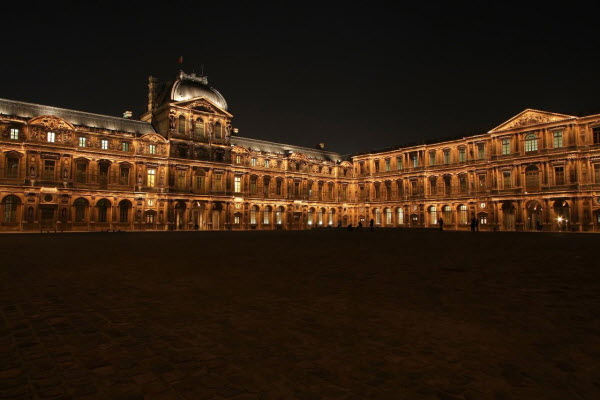
You're standing in the Louvre's Cour Carrée, the square courtyard. Even people who have visited Paris several times often don't know it exists. At night it feels like another world, quiet and beautiful. If Gil in Midnight in Paris time-traveled to the 1920s, you've just time-traveled to the Renaissance.
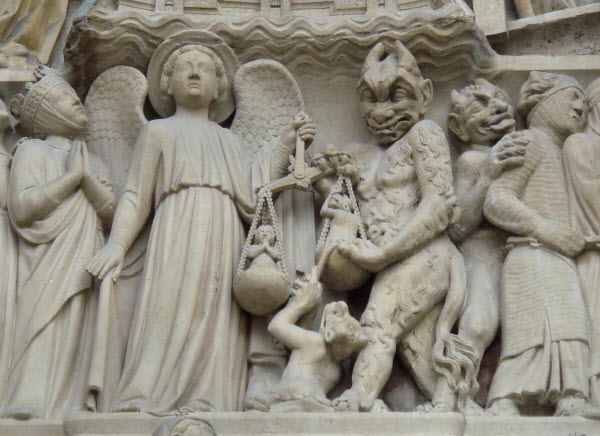
The Louvre is usually described as Renaissance architecture. The Renaissance, which moved from a God-centered Middle Ages to a human-centered revival of antiquity, began in the 14th century and took off in earnest from the 15th. But the Louvre was first built in the 12th century, in the medieval period. It began as a fortress built by King Philippe Auguste to protect the capital from the English. So how did a medieval building become Renaissance? A 16th-century king, Francis I, converted it. He was completely taken with the Renaissance blooming in Italy, where artists such as Leonardo da Vinci and Michelangelo were working at the time. Even after returning to France, Francis wanted their work near him, so he wrote to them, promising to treat them well if they came. Leonardo accepted and moved to France; Michelangelo declined. That's why the Louvre holds the Mona Lisa and other late works by Leonardo. Francis turned the old fortress into a Renaissance palace and made it his home.
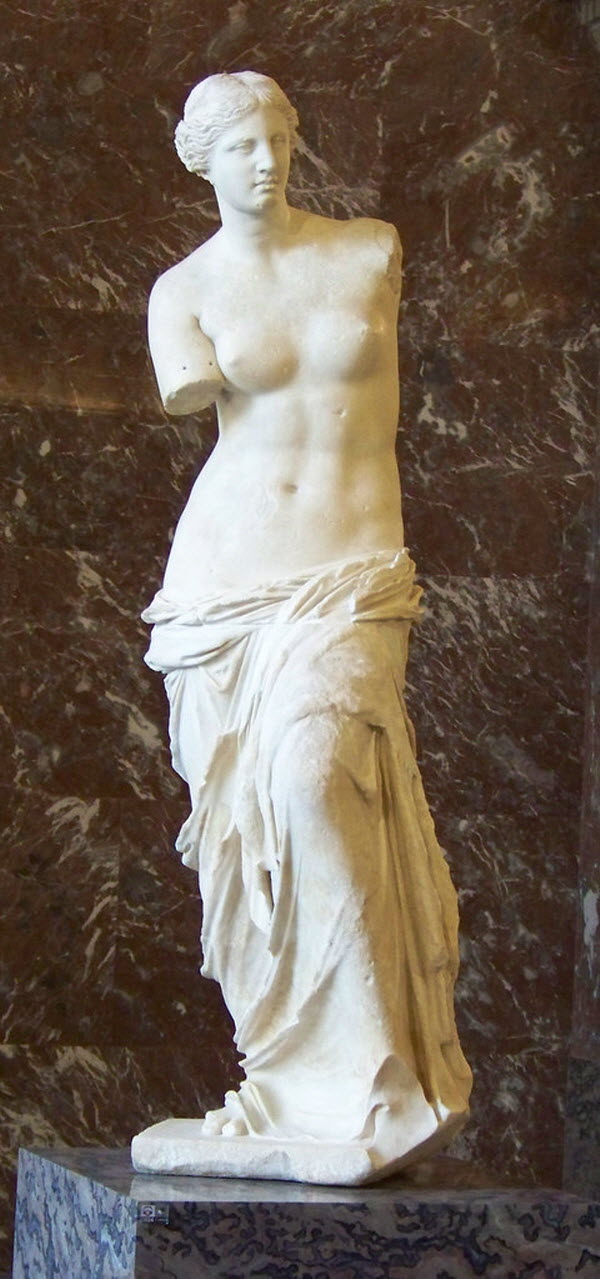
So what defines Renaissance style? The Renaissance revived ancient Greece and Rome. Unlike the God-centered Middle Ages, it used human reason to render the proportions of the body, perspective and depth. In the medieval period, God mattered most, so artists ignored proportion, drawing God large and everything else small, with almost no depth or perspective. In ancient Greece and Rome, by contrast, people studied body proportions, and our modern standards of beauty took shape. The ideal eight-head-tall figure and the S-curve made by stepping one foot forward and shifting the balance both date from then. A perfect example is the Venus de Milo, an ancient work by an unknown artist with flawless proportions; the Winged Victory of Samothrace, which looks ready to take off into the sky, is also ancient. The same traits show up in architecture: perfect symmetry, balance, proportion and order, all built into the Louvre. Just look around this square space and you can see how symmetrical it is. Do you remember which gate you came in through? They all look alike, and if you're busy snapping photos you can easily lose your bearings. We entered through the gate facing the Institut de France. The gate to your left leads to the Louvre's emblem, the glass pyramid.
Before you head there, step up close to the building and look at the columns. They look like something from a Greek or Roman temple. Ancient columns come in three kinds. A plain top is Doric; a top with two scrolls like ram's horns is Ionic; a top decorated with leaf-like ornament is Corinthian. You can see all three in one place at the Colosseum in Rome: Doric on the first level, Ionic on the second and Corinthian on the third. If Rome is on your itinerary, check for yourself. I've been to the Colosseum twice without knowing this and was really sorry when I found out later. If Rome isn't on your trip, the columns right in front of you, with their lush leaf details, are a Renaissance revival of those ancient styles. Imagine the Colosseum from here, and check it out next time you're in Rome.
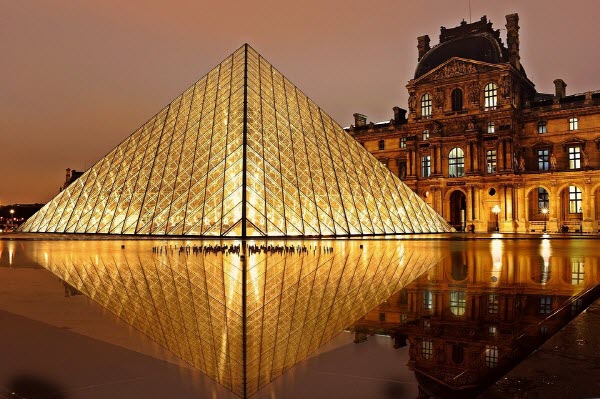
After you come through the gate and before you head down the stairs, you can see the huge "mama pyramid," three little "baby pyramids," and the Renaissance Louvre all in one view. It's my favorite night view in Paris after the Eiffel Tower. The Louvre doesn't open in the evening except on its late-night days, Wednesday and Friday, so coming at night lets you see a calm Louvre you can't get by day. Photos taken under the streetlamps also flatter your face. I said the Louvre's hallmark is symmetry and balance. Compare the two sides on either side of the central pyramid: they're nearly mirror images. Still, this pyramid doesn't look like it dates from the 16th century. Glass came into architecture fairly recently, and it's a hallmark of modern buildings. The Louvre has more than 800 years of history, but the glass pyramid is only about 30 years old. It was built in 1989. That year again. It was the 200th anniversary of the 1789 Revolution, and just as the Pont Neuf was restored, so was the Louvre.
The museum had a problem. It consists of three wings. You're standing in the Sully Wing; with your back to it, the Richelieu Wing is on your right and the Denon Wing on your left. Before the glass pyramid, you had to enter each wing through its own door, pass a ticket and bag check, see the exhibits, leave through the same door, and go through another check to enter the next wing. The pyramid solved that traffic jam, letting visitors enter once and move between wings from the inside. Even so, it drew heavy opposition. People couldn't accept an Egyptian-style pyramid in the middle of a Renaissance palace, and they weren't happy that its designer, I. M. Pei, was a Chinese-American. But once it was built, it proved extremely convenient, the glass brought in daylight so the lower level needed less lighting and saved on electricity, and it blended into the Louvre better than expected. Little by little it won people over, and it is now the Louvre's symbol, loved even by the French.
When you've taken enough photos, note that the rest of the route is too far to walk and requires transport. I suggest ending here tonight and saving the remaining stops for another day. The next stop, Bir-Hakeim Bridge, also looks lovely by day or at sunset, so you could visit then. If you still have plenty of time, take transport over to Bir-Hakeim now.