Paris · City Walks
Inside Notre-Dame: Rose Windows and Joan of Arc
Paris · Paris, France
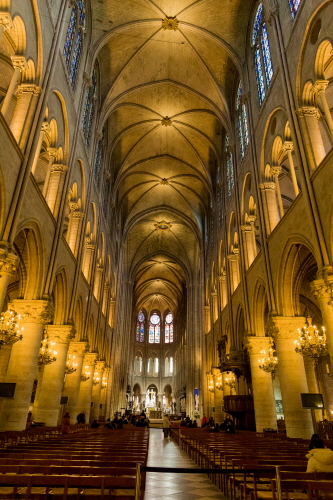
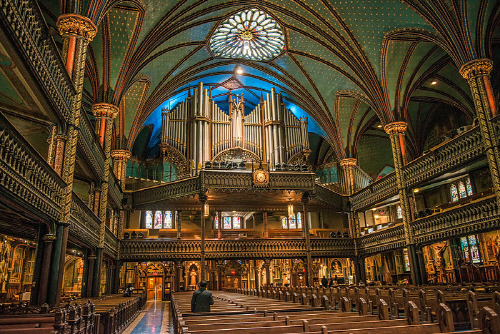
Step inside and a solemn, reverent hush settles over you. Everything that defines Gothic architecture is here: soaring pointed arches overhead, stained glass glowing even in the dim light, and sculptures filling every corner. If the cathedral feels far bigger than it looked from outside, close your mouth for a moment and start your tour counterclockwise.
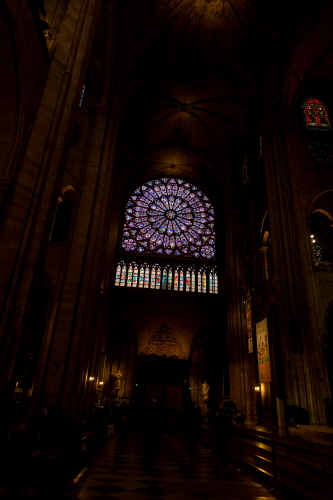
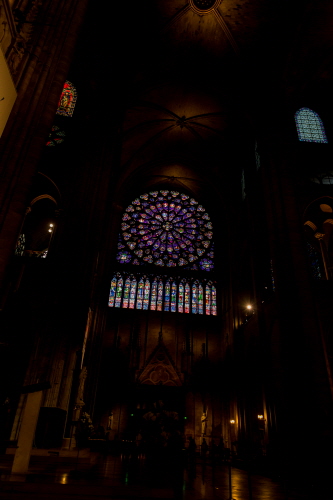
Pass the chapels along the right side and head toward the center, near the altar, and you'll reach two enormous rose windows: the south rose window on the right and the north rose window on the left. The south window is best seen from the opposite side, so you'll admire the north one first. Stained glass, rose windows included, traces back to the colored-glass windows of Islamic architecture in the Middle East. As Islamic styles spread into Europe, so did the craft of colored glass, and since this coincided with the rise of Gothic building, the two developed together. Gothic structures allowed for huge windows, which made stained glass one of the style's signature features. Among Gothic churches, Notre-Dame is especially famous for its rose windows, and at 13.1 meters across, the rose window is said to be the largest in Europe. Each window features biblical figures. The north rose shows the Virgin Mary at the center, surrounded by figures from the Old Testament. The south rose has Christ at the center, with the twelve apostles and saints, including the Virgin Mary, around him.
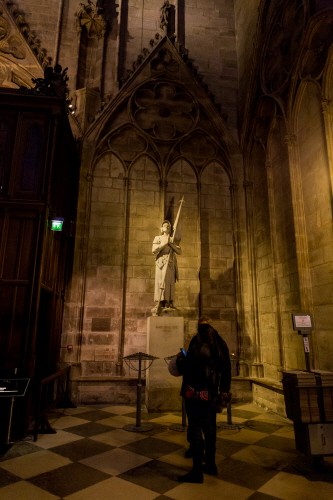
Before you head behind the altar, look for the statue of Joan of Arc just below the south rose window. She appeared like a comet toward the end of the Hundred Years' War between France and England, just as France was falling into ever deeper ruin. Inspired by a young girl who claimed to have received a message from an angel, French soldiers and ordinary people felt their patriotism reignite, and France was able to turn the war toward victory. That is why Joan came to be called the Goddess of Victory. She even saw Charles VII crowned king. But once he was on the throne, the story goes, Charles VII grew jealous of her rising popularity and stopped listening to her. When English forces attacked again, Joan went into battle without his help, was defeated and was taken prisoner. The English offered to release her for a ransom, but Charles VII, who had no love for her, refused, or so the story goes. She was put on trial several times, and her claim to have acted on divine revelation led to her being condemned as a witch and burned at the stake. She was just 19. Even facing the flames, she never denied her visions. Only after the war ended and the English had fully withdrawn did Charles VII clear her of the charge of witchcraft. Today she is revered as a saint of France, a byword for female strength, the heroine who saved the country and the woman who changed the world through divine guidance. As you stand before her statue, remember that this very cathedral hosted the trial that restored her honor.
Now walk toward the back of the altar, where you'll find the entrance to the treasury museum. It displays relics kept at the cathedral, the most important being a fragment of the True Cross and the Crown of Thorns. Continue around behind the altar and all the way to the opposite side of the cathedral to complete the loop. Before you leave, glance up at the back of the nave: there is another rose window, with a huge pipe organ beneath it. It is said to be the largest in France, with some 8,000 pipes. On days with an organ concert, or during the organ music at Mass, you can hear its rich, clear sound fill the space. When you are done, leave the cathedral and head for the next stop, the Conciergerie.