Paris · Architecture
Notre-Dame Cathedral: The West Façade
Paris · Paris, France
The final stop on the tour is the front of Notre-Dame, the largest church in Paris: the west façade. It's considered the essence of French Gothic, combining vertical lines divided by the three portals with horizontal lines formed by the towers and galleries. Let's work our way down from the top.
■ The towers and the Gallery of Chimeras At the very top are the two bell towers, which are distinctive in that they don't end in spires. Like Quasimodo, you can climb them, and the view of Paris from up there is excellent, though you'll face 422 steps first.
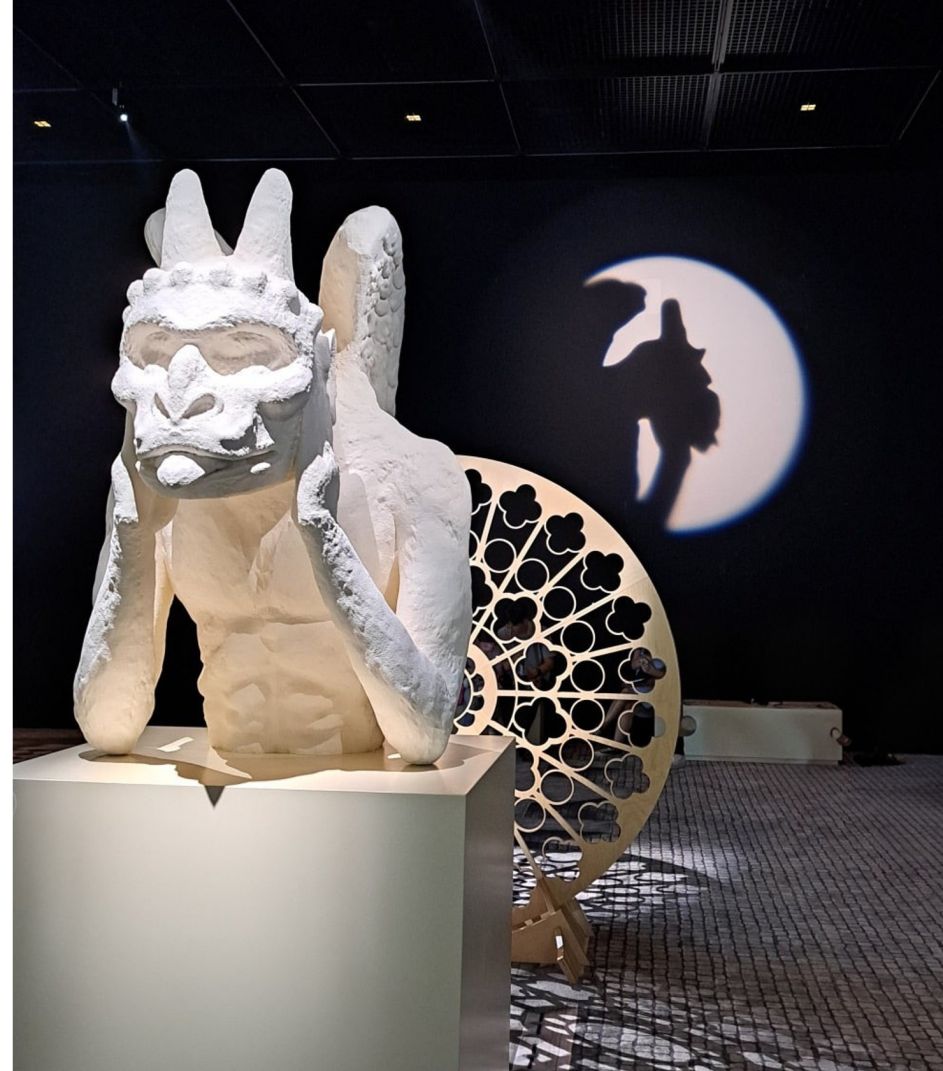
The section connecting the two towers is the Gallery of Chimeras. A cathedral can have two kinds of monstrous sculptures. One is the gargoyle, which acts as a rain spout, as you saw at Saint-Séverin. The other is the chimera, a purely decorative sculpture. The famous chin-in-hand, winged creature of Notre-Dame is a chimera. There are 54 in all, each with a different shape.
■ The Gallery of the Virgin and the Gallery of Kings Looking a little lower, you'll see the round rose window at the center of the façade. In front of it, two angels holding candlesticks that symbolize sin and salvation flank a statue of the Virgin, and on the pillars between the windows beside the rose window stand Adam and Eve. This is the Gallery of the Virgin.
Below it is the Gallery of Kings. During the French Revolution it was mistaken for statues of the kings of France, destroyed and later restored. In fact, these statues represent 28 generations of the kings of Judah before Christ, not French kings.
■ The three portals Look at the three doorways below. Learn a few terms first, since you'll meet them in other cathedrals in France and Europe. The pillar between doors is the trumeau, and the sculpture above a door has three parts: from the top, the tympanum, the upper lintel and the lower lintel. They are usually read from bottom to top and from left to right.
The central door is the Last Judgment Portal. The lower lintel shows the dead rising from their graves. On the upper lintel, the archangel Michael weighs souls on a scale while two demons try to tip it, with the chosen on the left and sinners gripping chains on the right. At the center of the top tympanum is Christ, flanked by angels holding the cross, the spear and the nails, and the kneeling figures are Mary and Saint John. The trumeau carries a figure of Christ and the embrasures hold statues of the Twelve Apostles. The archivolts show virgins, some with lit lamps and some with lamps put out. See if you can spot them.
The left door is the Portal of the Virgin. On the lower lintel, three prophets and three kings of Israel hold scrolls inscribed with scripture. The upper lintel shows the death of the Virgin Mary, surrounded by Christ, the Twelve Apostles, and the apostles Paul and John. The tympanum shows Mary, honored as the Queen of Heaven, with Christ. Beneath the trumeau are Adam and Eve, and in the embrasures is Saint Denis, who is linked to Montmartre.
The right door is the Portal of Saint Anne. The lower lintel shows Mary's parents, Saint Anne and Joachim, and the wedding of Mary and Joseph. The upper lintel shows key scenes from the life of Christ: the Annunciation, the Visitation, the Nativity and the Adoration of the Magi. The tympanum shows Mary and the infant Jesus. The trumeau is dedicated to Saint Marcellus, one of Paris's patron saints. In the embrasures, the third figure from the left is King Solomon and the sixth is King David.