Paris · Painting
Same Dance, Different Warmth: Renoir's Dance in the City and Dance in the Country
Musée d'Orsay · Paris, France
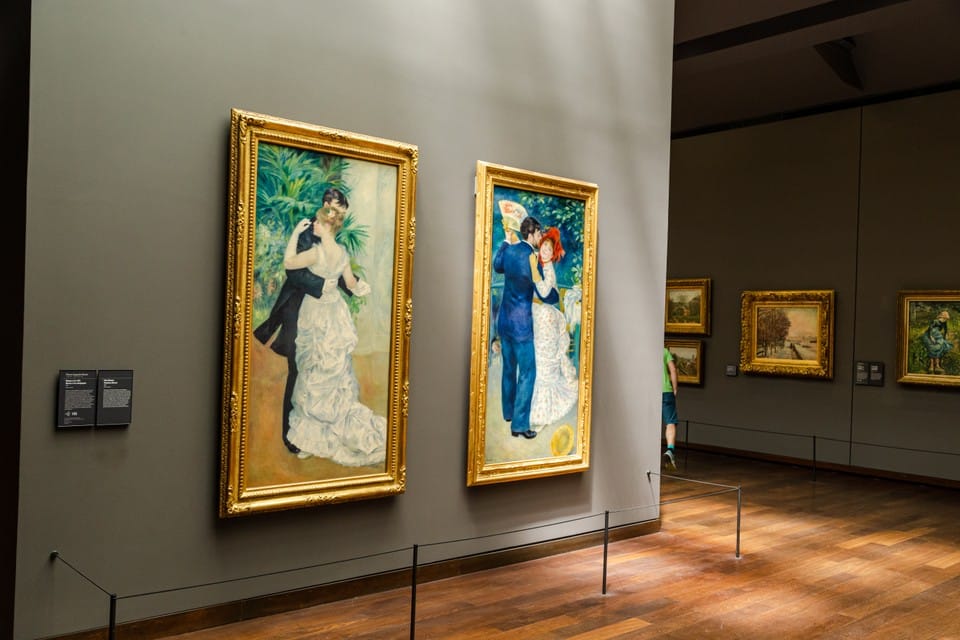
Renoir, who loved painting dancers, created two companion pieces both originally titled simply Dance. Each painting's character turned out to be so distinct that they're now better known as Dance in the City and Dance in the Country.
The indoor scene — a woman in a white dress waltzing — is Dance in the City. The man is Renoir's friend Lhote, and the woman is Suzanne Valadon, a model popular among Impressionist painters at the time. Her face is only half visible, leaving her expression hard to read, which may be why the whole painting carries a certain coolness.
The outdoor scene — a woman holding a fan as she dances — is Dance in the Country. The man is Lhote again, but the woman here is Aline Charigot, who would later become Renoir's wife. She was not yet twenty at the time, more than two decades younger than Renoir, and the two are said to have loved each other deeply enough to eventually marry despite the age gap — which perhaps explains the warmth and tenderness that radiate from this canvas.
Same subject, opposite moods. Both paintings date to 1883, a period when Renoir was already an established name. After his Salon successes in 1878 and 1879 — the first Impressionist to win that kind of recognition from the official art establishment — his career moved along a more secure path than many of his peers'. With that comfort came the means to travel to Italy in 1881, where he was deeply moved by the work of Raphael and other old masters. These two paintings were made shortly after his return.
The shift shows. The snapshot-like compositions and the subject of ordinary Parisians enjoying a holiday still belong firmly to Impressionism, but the more defined contours around his figures and the smoother handling of paint reveal a classical influence taking hold. From this point on, the Impressionist palette would gradually fade from Renoir's work as he moved toward a new style — and these two paintings stand right at that turning point.