Paris · Painting
A Code of Gratitude Hidden in Paint: Manet's Portrait of Émile Zola
Musée d'Orsay · Paris, France
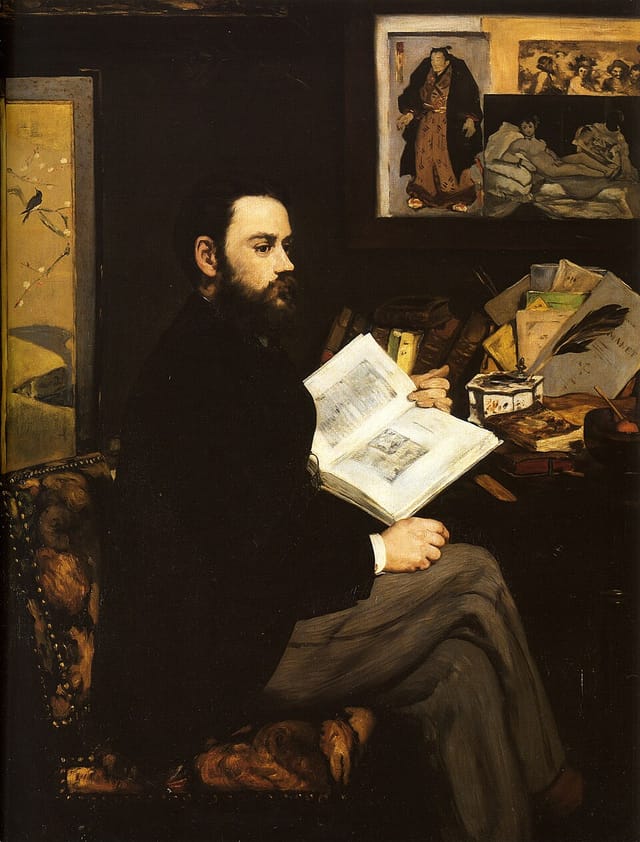
The man in this painting is Émile Zola. Not a familiar name in Korea perhaps, but in France, he's celebrated as a famous novelist and journalist. He was one of the very few people who defended Manet's paintings at a time when critics attacked them relentlessly, and Manet painted this portrait as a gift to express his gratitude.
The setting is Manet's own studio, though it isn't an exact likeness of the real room — he wove in various elements meant to signal the bond and closeness between the two men. On the desk sits a book with a blue cover reading "Manet" — a pamphlet collecting the articles Zola wrote defending him, an object that meant a great deal to Manet personally.
The three paintings hanging on the wall are also worth a closer look. One is a black-and-white rendering of Manet's own Olympia, a painting that had drawn savage criticism from contemporary critics. While everyone else condemned it, Zola alone praised it as "a masterpiece carrying the artist's own flesh and blood," and that moment of defense was what first brought the two men close. Behind Olympia hangs The Triumph of Bacchus by the Spanish painter Velázquez. While many painters of the era admired Italian art, Manet reserved his greatest admiration for Spanish painting, and Velázquez above all — a taste Zola shared, which is why this painting appears here as well. To the left of Olympia is a Japanese ukiyo-e woodblock print from the Edo period, and to Zola's left, a Japanese folding screen — both reflecting the wave of Japonisme sweeping Parisian art circles at the time, and another shared enthusiasm between the two men. That Japanese influence would later shape the Impressionist painters profoundly, helping bring flattened, two-dimensional compositions into wide use.
But the real message Manet wanted this painting to carry lies elsewhere. The thick book in Zola's hand is Charles Blanc's History of Painters. Manet had been repeatedly criticized as a painter whose work lacked quality or understanding, and through this portrait he sought to argue the opposite: that a man of real intellectual substance, reading a serious work like this, endorsed his painting — and that endorsement itself proved his art's worth. Zola surely grasped exactly what Manet was conveying the moment he saw the finished portrait, and he came to love it deeply. The friendship between the two men, which once seemed as though it would last forever, eventually cooled as Manet's artistic direction and Zola's own views grew apart. Even so, Zola kept this portrait in his own study until his death. After he passed away, his wife lent it to the Louvre free of charge, and it was later moved here to the Musée d'Orsay.